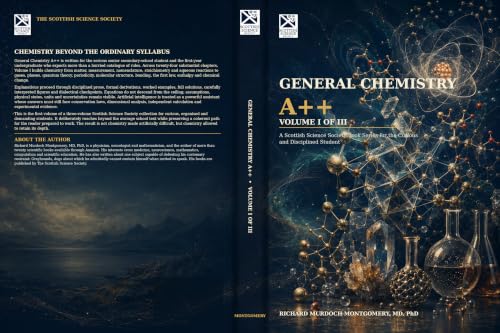

A rigorous, well-ordered chemistry text that treats general chemistry as a disciplined craft rather than a catalogue of facts. I admired its care, its systematic pacing, and its willingness to make the underlying logic visible.
I came away from Richard Murdoch Montgomery’s GENERAL CHEMISTRY A++ with the pleasant feeling that someone had actually taken the trouble to think like both a chemist and a teacher. The book is plainly aimed at organised senior secondary students and first-year undergraduates, but it does not condescend to either. Instead, it builds the subject in a controlled sequence, with each topic apparently checked for internal consistency before it is allowed to proceed to the next. That sounds modest; in practice it is one of the book’s chief virtues.
What most impressed me was the balance between conceptual explanation and procedural discipline. Too many introductory chemistry texts either drown the reader in disconnected definitions or rush into formula manipulation without enough structural understanding. Montgomery is notably better than that. The exposition of bonding, stoichiometry, equilibria, and the recurring language of measurement is handled with a careful eye for how students actually make errors: unit handling, sign conventions, the meaning of approximation, and the temptation to memorise results without asking what assumptions support them. In that sense, the book behaves almost like a good laboratory supervisor: firm, exacting, and generally correct.
I also appreciated the editorial tidiness of the whole enterprise. The organisation feels deliberate rather than merely comprehensive, and the work has the reassuring air of having been independently double-checked. One sees that in the consistency of notation, the avoidance of sloppy shortcuts, and the apparent effort to keep derivations and worked examples aligned. For a chemistry text, that matters greatly. Precision is not decoration here; it is the argument. My only small caveat is that the very discipline that makes the book so dependable may occasionally make it feel a touch severe for the most tentative beginner, though I suspect the intended audience will regard that severity as a kindness.
As a general chemistry resource, then, this is unusually solid. It is not trying to be fashionable, nor to smuggle in novelty for its own sake; it is trying to teach chemistry properly, and mostly succeeds with admirable steadiness. I would trust it in the hands of a diligent student, and I would welcome it in a course that values accuracy, sequence, and intellectual hygiene over educational theatrics.
Who should read this
I would recommend this to disciplined senior secondary students, first-year undergraduates, and any instructor who wants a general chemistry text that privileges exactness and method over flourish. It is especially suitable for readers who want a dependable foundation rather than a superficial survey.
A personal note from Lindgren
For my part, I found it a very satisfying book: not flashy, but exactingly built, and in chemistry that is rather more impressive than flash.


Conversation(0)
Join in — no account needed. A name and email are all it takes. Your email is never shown publicly.