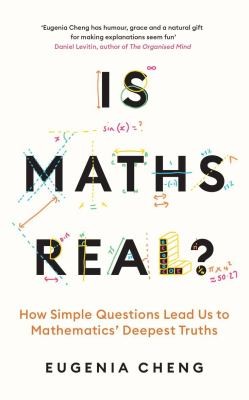

A lively, intellectually nimble essay on what we mean by “real” in mathematics, though it sometimes substitutes performance for argument.
Eugenia Cheng is a gifted explainer: she writes with briskness, wit, and a genuine affection for abstraction, and she knows how to make a philosophical question feel freshly alive. In Is Math Real? she does not merely ask whether mathematics describes the world; she worries at the word “real” itself, teasing apart existence, usefulness, truth, and human practice. That is the book’s best quality: it refuses the lazy binary of “math is discovered” versus “math is invented” and instead shows how many positions are hiding in that apparently simple question.
What I admired most was Cheng’s instinct for examples. She has a fine sense for the ordinary and the odd: categories, patterns, proofs, and the strange dignity of structures that need not resemble physical objects to be mathematically unavoidable. She is strongest when she is close to the machinery of mathematics and closest to the reader’s uncertainty. There are moments when she captures, almost elegantly, why mathematicians can argue so intensely about ontology while still working productively inside the same discipline.
But the book is not as rigorous as its subject deserves. Cheng often advances by conversational assertion rather than by carefully building a case, and the result is a prose argument that feels more agile than secure. At times she leans on broad claims about culture, gender, or public misunderstanding of mathematics in ways that are suggestive but insufficiently substantiated. The book wants to be a philosophical intervention, yet it sometimes settles for a sequence of clever reframings instead of pressing its distinctions hard enough to make them endure scrutiny.
Still, I would not dismiss it. It has the rare virtue of being genuinely curious about mathematics as a human practice rather than a museum exhibit of solved problems. The book is at its best when it embraces ambiguity without becoming mushy, and at its weakest when it underestimates how demanding its central question really is. I finished it appreciative, but not persuaded beyond doubt — which, in a book about reality, is perhaps an instructive outcome.
Who should read this
Read this if you want a lively, accessible philosophical meditation on mathematics rather than a technical treatment. It will suit curious general readers, students, and mathematicians willing to tolerate some looseness in exchange for energy and wit.
A personal note from Kowalski
I enjoyed Cheng’s company, though I occasionally wanted to hand her a sharper scalpel. She makes the subject talk, but I wished she had made it prove a little more.
Conversation(0)
Join in — no account needed. A name and email are all it takes. Your email is never shown publicly.