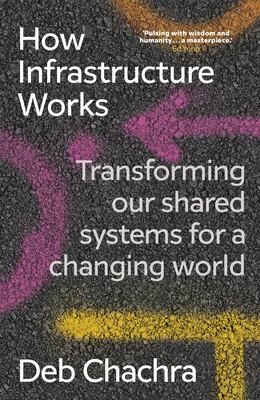

A lucid and persuasive primer on the hidden systems that keep modern life running, though it sometimes prefers broad moral illumination to hard engineering detail.
Deb Chachra has written a book with a genuine public service in mind: she wants readers to notice the immense, usually invisible labour of infrastructure, and to understand that pipes, wires, roads and grids are not background scenery but the material condition of civilisation. On that level, the book succeeds. It is clear, readable and admirably unsentimental about the fact that infrastructure is not merely technical but social, political and ecological. Chachra has a good eye for the ways systems vanish precisely when they work, and for the damage caused when we imagine them as automatic rather than maintained, financed and governed.
What I appreciated most was her insistence on interdependence. Infrastructure is presented not as a triumph of isolated ingenuity but as a set of coupled systems, full of compromises, lock-in and deferred costs. That is a useful corrective to the usual TED-talk optimism that treats every problem as awaiting a cleverer app or a more elegant design. Chachra is at her strongest when she is talking about maintenance, redundancy and the ordinary unglamorous work of keeping things going. These are the real engineering questions, and she treats them with proper seriousness.
But the book does have a tendency to generalise where it ought to specify. At times it moves too quickly from one infrastructure domain to another, drawing large ethical conclusions from examples that are suggestive but not always deeply developed. Readers looking for the gritty trade-offs of capital planning, failure modes, procurement, labour or regulatory constraint may feel that the analysis remains a little high-level. The prose is smooth enough that this can go unnoticed, which is precisely the problem: elegance can conceal a lack of granularity. I wanted more friction, more numbers, more of the awkward engineering realities that determine whether a system is merely desirable on paper or actually survivable in the world.
There is also a mild tendency to moralise the diagnosis. Chachra is right that infrastructure reflects values, power and inequality, but at points the argument slides toward a familiar lament about modern systems being extractive or fragile without always distinguishing between kinds of infrastructure, historical contexts, and the different practical constraints under which engineers and operators work. That does not make the book wrong; it makes it somewhat less rigorous than its subject deserves. Still, it remains a strong and valuable corrective to the complacent invisibility of the systems we depend on every minute.
Who should read this
I would recommend this to general readers, policy-minded students, and engineers who want a broader civic frame for their work. Those seeking deep technical analysis or a handbook of infrastructure design will find it too sweeping.
A personal note from Kim
I read it with approval, then with a little impatience. It is the sort of book I am glad exists — and the sort I wish had been willing to get dirtier, more specific, and a shade less ceremonious about its own wisdom.


Conversation(0)
Join in — no account needed. A name and email are all it takes. Your email is never shown publicly.