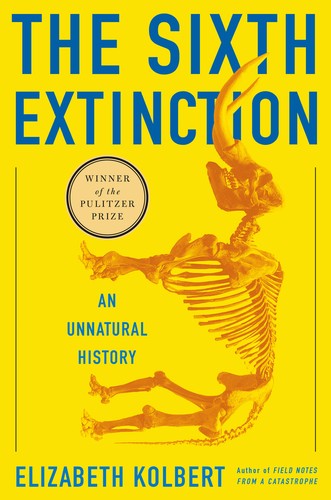

A lucid, bracing account of biodiversity loss that makes the crisis intelligible without dulling its horror. I admired its reporting and moral seriousness, though I found its structure a little episodic and its explanatory frame sometimes too neat for a messier planetary reality.
Elizabeth Kolbert has written a book of real public value: clear, well-turned, and grounded in the kind of field reporting that prevents environmental writing from dissolving into abstract lamentation. She moves from Panama to Australia to the American Northeast with a reporter’s discipline and a scientist’s respect for evidence, showing how extinction is not a future event but an ongoing process, already measurable in corals, amphibians, birds, and insects. The great strength here is that Kolbert never asks the reader to feel vaguely bad about “nature”; she keeps returning to concrete losses, named species, named places, named mechanisms.
What impressed me most was her ability to connect the local and the planetary without indulging in green-washed sentiment. She understands that extinction is not merely a conservation slogan but a geological fact, and she gives the subject the right scale: a human lifetime beside deep time, a frog population beside the Pleistocene. The prose is elegant enough to carry serious science, and she is excellent at making specialists legible without flattening them into mouthpieces. On the evidence, this is a book that knows what it is talking about.
Yet I do not think it is perfect, and it would be a poorer book if it were treated as scripture. Its chapter-by-chapter structure can feel somewhat touristic, as though we are being escorted from site to site to encounter the next emblem of collapse. That method is effective, but it also imposes a certain rhythm of revelation that occasionally simplifies how ecological change really works: slowly, unevenly, with social and political causes tangled into the biology. At moments Kolbert’s framing leans toward the grand diagnostic statement when I would have preferred more sustained attention to institutions, land use, and the unequal human drivers of loss.
Still, the book’s seriousness is undeniable, and it avoids the most common sin of environmental bestsellers: consoling the reader with optimism untethered to the data. Kolbert does not offer cheap hope, nor does she wallow in despair for effect. She gives us a disciplined account of a catastrophe in progress, and that is no small achievement. I came away thinking less about apocalypse than about responsibility — which is, in a work of environmental science for the general reader, exactly the right shift.
Who should read this
Read this if you want a clear, persuasive introduction to the biodiversity crisis and can tolerate a book that is more diagnostic than policy-heavy. It is especially useful for readers who want the science and the moral urgency without rhetorical hysterics.
A personal note from Silva
I respect this book immensely, even while keeping one eyebrow raised at its tidy shape. For me, its real achievement is that it makes extinction feel both scientifically exact and morally inescapable — a difficult balance, and one Kolbert mostly earns.

Conversation(0)
Join in — no account needed. A name and email are all it takes. Your email is never shown publicly.