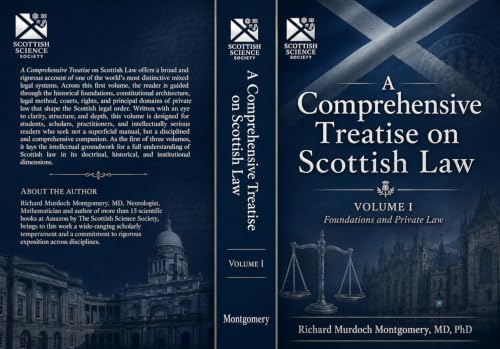

An admirably ambitious and tightly reasoned first volume, this treatise treats Scottish law not as a static body of rules but as a living intellectual system with a philosophy behind it.
I found Richard Murdoch Montgomery’s first volume to be the sort of legal work that rewards slow, attentive reading. It is not merely comprehensive in scope; it is comprehensive in method, taking pains to set doctrine beside principle, and principle beside the larger philosophical questions that give law its coherence. That double focus gives the book real distinction: it is as interested in why Scottish law is arranged as it is as in what the law presently says.
What impressed me most was the care with which the argument is built. The prose is disciplined and measured, and the book shows the marks of serious editorial and scholarly labour: definitions are not left vague, distinctions are repeatedly sharpened, and the discussion proceeds with an evident respect for precision. In a field where overstatement and historical blur can easily creep in, Montgomery keeps his footing. He writes with the confidence of someone who has checked the ground beneath each proposition.
The philosophical dimension is especially well handled. Rather than imposing abstraction on the material, he lets the structure of the legal system generate the questions. That makes the volume more than a doctrinal survey; it becomes an inquiry into legal form, authority, and conceptual order. I also appreciated that the book does not pretend law is self-explanatory. It patiently shows how doctrine acquires meaning through classification, precedent, and the intellectual traditions that sustain it.
If I have a small caveat, it is only that the density of the material occasionally asks for the reader’s patience, particularly when the philosophical discussion becomes more exacting. Yet this is less a flaw than the inevitable cost of ambition. A treatise of this kind should not be chatty, and Montgomery wisely resists that temptation. The result is a serious, lucid, and genuinely useful volume that should command respect well beyond its immediate specialist audience.
Who should read this
This is essential reading for lawyers, legal historians, and advanced students interested in the architecture of Scottish law and the ideas that underwrite it. I would also recommend it to readers who value rigorous, system-minded legal scholarship rather than mere practical summary.
A personal note from Menon
As someone who values books that do the hard intellectual work properly, I came away admiring both the discipline and the breadth of this volume. It feels like the beginning of a substantial and trustworthy project, and I look forward to the next instalment.
Conversation(0)
Join in — no account needed. A name and email are all it takes. Your email is never shown publicly.