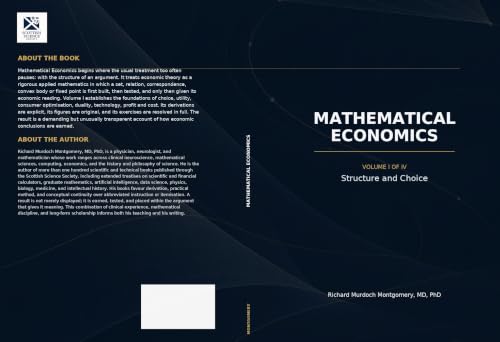

A rigorous, unusually lucid treatment of equilibrium, strategy and uncertainty that earns its place on the serious mathematical economist’s shelf.
I came to this second volume with high expectations, and what struck me first was the author’s discipline of exposition. Montgomery does not merely assemble the standard apparatus of mathematical economics; he arranges it so that each layer of theory feels earned. The transition from equilibrium analysis to strategic interaction and then to uncertainty is handled with a reassuring architectural sense, as if the reader is being led through a well-built proof rather than a grab-bag of techniques.
What I most admire is the book’s fidelity to the mathematics without becoming inhospitable. The arguments are stated with enough precision to satisfy a reader who cares about assumptions, existence conditions and logical dependencies, yet the presentation remains recognisably pedagogical. In a field where authors often gesture at intuition and then hide the machinery, Montgomery is commendably explicit. He is at his best when clarifying how equilibrium concepts behave under different informational structures, and when showing that strategic reasoning is not an ornament on economics but one of its central formal languages.
The treatment of uncertainty is especially strong. Rather than presenting uncertainty as a decorative complication, the book makes it structurally important, and that is the right choice. I found the discussion of stochastic or probabilistic formulations particularly convincing because it respects the limits of the models while still drawing out their explanatory power. This is the sort of book that understands that elegance in economics is not the same as simplification; it is the careful management of complexity.
If I have a mild reservation, it is only that the density of the material can make sustained reading demanding, especially for those without a firm mathematical foundation. But this is not a flaw of indulgence; it is the inevitable cost of seriousness. For the intended audience, the book offers something genuinely valuable: a coherent, carefully checked, and intellectually honest account of core analytic tools in modern economics.
Who should read this
This will suit graduate students and researchers in economics, applied mathematics, game theory, and related quantitative fields, especially those who want a principled, theorem-conscious treatment rather than a purely intuitive one. Readers looking for a lighter conceptual overview should start elsewhere, but those prepared to work will find the reward substantial.
A personal note from Menon
I admired the book’s restraint almost as much as its command: it never overclaims, and in mathematical economics that is a rare and welcome virtue.

Conversation(0)
Join in — no account needed. A name and email are all it takes. Your email is never shown publicly.