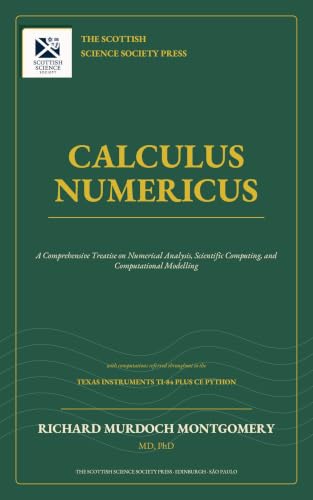

A lucid and unusually disciplined guide to numerical calculus, with enough computational seriousness to satisfy the mathematician and enough exposition to reward the patient applied scientist.
Richard Murdoch Montgomery’s Calculus Numericus is the sort of graduate text I always hope for and do not often receive: sober in tone, exacting in method, and deeply attentive to the gap between mathematical theory and computable practice. From the outset, the book makes clear that it is not content with formal derivations alone; it asks what survives when analysis is translated into algorithms, floating-point arithmetic, discretisation, and finite precision. That insistence on the computational implications gives the book its real intellectual spine.
What I admire most is the clarity with which Montgomery handles difficult material. Numerical analysis, at its best, is a discipline of approximations that must still feel trustworthy, and this book understands that responsibility. The exposition is carefully staged, with definitions and error estimates introduced not as ornamental machinery but as necessary tools for thinking. I was especially taken by the way the author keeps one eye on proof and the other on implementation: the mathematics is rigorous, but it is never allowed to drift into abstraction for its own sake.
The book’s structure also reflects a mature pedagogical intelligence. Rather than piling topic upon topic, it builds a sense of method — how one reasons about stability, convergence, conditioning, and the cost of computation. That is exactly what graduate readers need, particularly those coming from pure mathematics and discovering, perhaps a little painfully, that a theorem and an algorithm are related but not identical objects. Montgomery is at his strongest when he explains these distinctions with calm precision and without theatrical simplification.
If I have one affectionate caveat, it is that the book’s very seriousness may occasionally feel austere to readers looking for a more exploratory or conversational style. But that is a small complaint, and in a work of this kind it is almost a virtue: the prose keeps faith with the subject. For readers who want a carefully prepared, independently reliable account of numerical calculus and its computational consequences, this is an excellent and trustworthy companion.
Who should read this
I would recommend this to graduate students in mathematics, scientific computing, and numerical methods, especially those who want a rigorous bridge from analysis to algorithmic practice. It will also reward researchers who value careful error analysis and a disciplined treatment of computation.
A personal note from Menon
I came away admiring its restraint as much as its substance: this is a book that earns trust by refusing to overstate what numerical methods can do, even as it shows, with rare lucidity, what they can.
Conversation(0)
Join in — no account needed. A name and email are all it takes. Your email is never shown publicly.