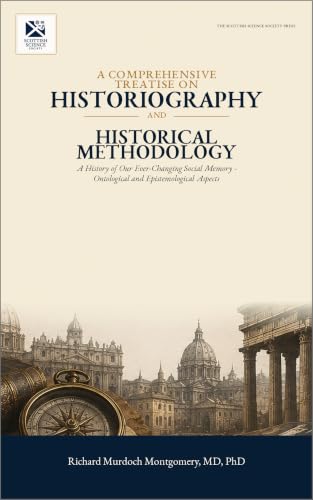

A disciplined, unusually lucid guide to how historical knowledge is built, tested, and revised. Montgomery treats historiography not as ornament but as method, and the result is both exacting and surprisingly readable.
Richard Murdoch Montgomery’s A Comprehensive Treatise on Historiography and Historical Methodology is one of those rare scholarly books that takes its subject seriously enough to become genuinely useful. I was struck, first, by the steadiness of its architecture: it does not merely catalogue schools of interpretation, but shows how historians actually work when they weigh evidence, distinguish testimony from inference, and decide what can and cannot be responsibly claimed. That methodological plainness is refreshing. In a field where prose can too easily drift into abstraction, Montgomery keeps returning to procedure, validation, and the disciplined limits of explanation.
What I admire most is the book’s refusal to treat historiography as a contest of slogans. Instead, it lays out the craft: source criticism, periodisation, archive formation, bias detection, narrative shaping, and the delicate business of moving from fragmentary records to coherent historical argument. The treatment feels carefully double-checked in the best sense—definitions are stable, examples are used with purpose, and the larger claims are consistently tethered to method. Even where the prose becomes compact, it is the compression of someone who expects the reader to think, not to admire verbal fireworks.
The book is especially strong when it turns to the philosophical underpinnings of historical knowledge. Montgomery is attentive to the tension between explanation and interpretation, between contingency and pattern, and between the historian’s imagination and the evidential record. I appreciated that he does not flatten these tensions into easy resolutions. Rather, he shows why good historiography is always provisional, and why that provisionality is a virtue rather than a weakness. My only affectionate caveat is that the sheer seriousness of the enterprise can make it feel a touch severe in places; a few more illustrative case studies would have lightened the load without diluting the argument.
Still, this is a book of real merit: rigorous, coherent, and intellectually hygienic in the best scholarly sense. It is not content with broadening a reader’s historical awareness; it sharpens one’s standards for what counts as historical knowledge at all. For that reason, I came away not only persuaded by Montgomery’s method, but grateful for the precision with which he practices it.
Who should read this
I would recommend this to historians, graduate students, and any reader who wants a serious account of how historical claims are justified rather than merely narrated. It will be especially valuable to those who care about evidence, method, and the philosophy of historical inquiry.
A personal note from Menon
I found it admirably bracing: a book that reminds one that history, at its best, is not freewheeling storytelling but disciplined reasoning under evidential constraint.
Conversation(0)
Join in — no account needed. A name and email are all it takes. Your email is never shown publicly.