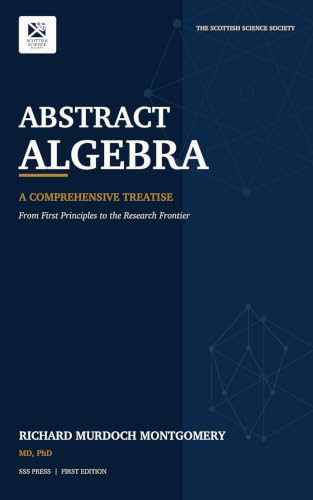

A rare algebra text that manages to be both encyclopaedic and disciplined: ambitious in scope, but kept in check by unusually clear exposition and a steady sense of what matters mathematically.
Richard Murdoch Montgomery’s Abstract Algebra is the kind of book I wish more graduate treatises aspired to be: patient without becoming ponderous, comprehensive without lapsing into catalogue. It begins from first principles with a seriousness that never feels patronising, and it builds outward in a way that makes the reader feel the internal logic of the subject rather than merely receiving its results as a list of definitions and theorems. I was particularly struck by the author’s willingness to slow down at structural pivots — groups, rings, modules, field extensions, representation-theoretic ideas — so that the architecture of the discipline becomes visible.
What distinguishes the book is not simply breadth, though there is plenty of that, but the manner in which breadth is earned. The exposition is carefully layered: examples are not decorative, but functional; proofs are not compressed into slogans; and the transition from elementary material to research-facing territory feels organic rather than abrupt. Montgomery writes as someone who understands that graduate algebra is often defeated by a lack of connective tissue, and he takes great pains to supply it. One comes away not merely with facts, but with a clearer sense of why certain constructions recur across modern algebraic mathematics.
I also admire the scholarly discipline of the treatment. In a field where authors are sometimes tempted to signal sophistication through unnecessary abstraction, this book keeps its eye on mathematical substance. The double-checking shows in the consistency of notation, the careful handling of hypotheses, and the absence of those small but corrosive slips that can undermine confidence in a technical text. When the book moves toward the research frontier, it does so with proper caution: it sketches directions, names problems, and indicates significance without pretending to settle what remains open.
If I have a small affectionate caveat, it is that readers looking for a brisk path through abstract algebra will not find much concession here; the book asks for sustained attention and rewards it generously. But that is scarcely a defect in a comprehensive graduate treatise. For students, instructors, and researchers who want a serious companion from foundational material to the threshold of current work, this is an impressive and admirably dependable volume.
Who should read this
I would recommend this most strongly to graduate students, instructors, and mathematically mature readers who want a rigorous, coherent guide to abstract algebra beyond the standard textbook level. It is especially valuable for those who prefer depth, precision, and structural understanding over speed.
A personal note from Menon
I found it deeply reassuring to read a mathematics book that is so clearly built with intellectual honesty. It is not merely informative; it is the work of an author who respects both the subject and the reader.

Conversation(0)
Join in — no account needed. A name and email are all it takes. Your email is never shown publicly.