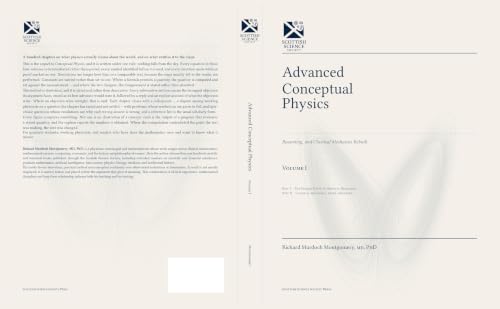

A rigorous and unusually serious reconstruction of introductory mechanics, this volume treats physics as an argument rather than a bag of tricks.
Richard Murdoch Montgomery has written a book that is refreshingly unwilling to flatter the reader. In this first volume of his Scottish Science Companion sequence, he rebuilds classical mechanics from the ground up, and what strikes me at once is the discipline of the method: definitions are not merely announced, they are earned; distinctions are kept sharp; and the reasoning is made to do the labour of persuasion. For a work that promises “conceptual physics,” it is notably unsentimental about vague metaphor. The result is a text that respects both the subject and the reader.
What I found most impressive is the book’s insistence on structure. The treatment of kinematics and dynamics is not content to parade formulas; it continually asks what the formalism is actually saying, and under what assumptions it is valid. That makes the presentation feel closer to a careful derivation than a popularisation. Montgomery is at his strongest when he exposes hidden dependencies—on frames, idealisations, measurement, and symmetry—because he does not merely mention these things, he uses them to rebuild the logic of mechanics. This is the sort of book that can genuinely improve a student’s mathematical conscience.
The prose is clear, but not simplistic, and the pedagogy is evidently deliberate. I admired the way apparently elementary notions are tested against edge cases and then restored in a cleaner form. One senses that the manuscript has been checked with an engineer’s suspicion and a theorist’s patience. If I have a small caveat, it is only that the density of the argument may occasionally ask more concentration than the casual reader expects; yet this is less a flaw than a sign that the author has refused to dilute the subject for convenience.
As a piece of physics writing, this is unusually credible because it does not confuse accessibility with looseness. It shows how classical mechanics can be made conceptually exact without being reduced to a sterile exercise in symbolism. The ambition is substantial, the execution disciplined, and the tone admirably free of grandiose claims. I came away with the sense that the author knows precisely what he is rebuilding, and why.
Who should read this
This is for students, teachers, and self-directed readers who want mechanics treated with genuine logical seriousness rather than breezy intuition. I would especially recommend it to anyone who has learned the formulas of classical mechanics but never quite trusted the arguments behind them.
A personal note from Bruno
I liked this immensely: it has the rare good manners to be exacting without being showy, and it assumes that rigor is a form of courtesy to the reader.
Conversation(0)
Join in — no account needed. A name and email are all it takes. Your email is never shown publicly.