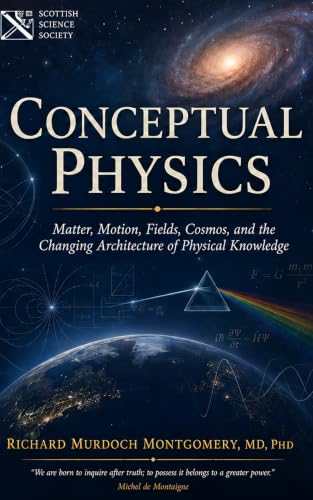

A rigorously conceived and unusually coherent guide to the architecture of modern physics, this book earns admiration for treating concepts as consequences of structure rather than as slogans.
Richard Murdoch Montgomery has written a book that takes the title’s word “conceptual” seriously in the best possible sense. What impressed me most is the insistence that matter, motion, fields, and cosmology are not separate compartments of knowledge but mutually constraining ways of describing one physical world. The exposition is careful and disciplined: where many texts rely on verbal analogy, Montgomery repeatedly returns to definitions, conservation principles, and symmetry arguments, so that the reader is not merely told what modern physics says but shown why its language has the shape it does.
The book’s strongest quality is its structural intelligence. It does not simply march from mechanics to fields to the cosmos; it makes the transitions feel necessary. In particular, I valued the way the author keeps formalism in view without allowing it to become opaque decoration. The equations are there to carry argument, not to signal sophistication, and they are integrated with enough interpretive commentary that one can see precisely where a statement is derived, where it is idealised, and where it is being elevated to a physical principle. That distinction, too often blurred in undergraduate and graduate texts alike, is handled here with exemplary care.
Montgomery is also unusually good on the changing architecture of physical knowledge. He does not present physics as a closed cathedral of finished truths, but as an evolving edifice whose load-bearing beams have shifted from mechanical models to field-theoretic and geometric ones. I found this historically informed perspective especially persuasive because it is never merely decorative. The historical material is used to sharpen the reader’s understanding of why certain concepts persist, why others were discarded, and why the most successful theories often rewrite the very terms in which questions can be asked.
If I have one affectionate reservation, it is that the book occasionally asks the reader to keep several layers of abstraction in play at once, and a few will welcome a slightly gentler hand in the most compressed passages. But this is a minor matter in a work of genuine precision and ambition. It is rare to find a book that is simultaneously pedagogically humane and intellectually unsparing; Montgomery has achieved that balance with real distinction.
Who should read this
This will reward graduate students, advanced undergraduates, and any physicist who wants a concept-first account that is still faithful to the mathematics. I would especially recommend it to readers who suspect that too many physics books confuse clarity with simplification.
A personal note from Bruno
I finished it with the agreeable sense that the author had done the hard work one hopes for but too rarely finds: not merely explaining physics, but showing how its concepts earn their authority.
Conversation(0)
Join in — no account needed. A name and email are all it takes. Your email is never shown publicly.