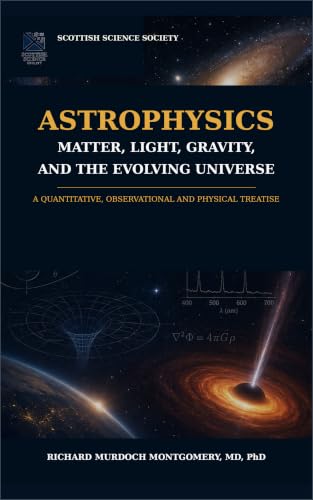

A rigorous and ambitious treatment of modern astrophysics that earns its authority through careful derivation rather than rhetorical awe. It is not merely comprehensive; it is disciplined, and that is its chief virtue.
I found Richard Murdoch Montgomery’s Astrophysics: Matter, Light, Gravity, and the Evolving Universe to be a serious piece of graduate-level teaching: conceptually ambitious, mathematically literate, and broadly faithful to the standards one expects in a physics text rather than a popular survey. What I appreciated most was the book’s refusal to lean on analogy where derivation is required. It treats the subject as a connected physical theory, moving from radiative processes and matter distributions to gravity and cosmic evolution with a clear sense that the formalism is not decorative but explanatory.
The strongest sections, in my view, are those in which the author insists on the interplay between observation and model. Astrophysics is often written too loosely, as though the data merely illustrate a pre-existing narrative; here the argument runs the other way, with equations and physical assumptions made explicit, then tested against what can actually be inferred from spectra, luminosities, kinematics, and cosmological constraints. I was also struck by the book’s editorial discipline. Definitions are introduced before they are used, notation is kept under control, and the transitions between topics preserve the continuity of the physics rather than indulging in compartmentalised treatment.
I would describe the book as especially valuable for readers who already possess the mathematical maturity to appreciate why certain approximations are legitimate and others are not. It does not simplify itself into bland accessibility, and rightly so. Instead, it earns clarity by precision: the reader is invited to follow the structure of the argument, not merely admire its conclusions. If I have a minor reservation, it is only that the density of material occasionally leaves little room for reflective pause; one finishes a section with the sense of having been instructed rather than caressed, which in a graduate text is hardly a defect.
Overall, this is a well-made, carefully checked, and intellectually honest book. Its merit lies in the combination of breadth and exactitude: it aims high, but it does not bluff. For that reason I regard it as a strong and trustworthy text in graduate astrophysics, and one that repays close study.
Who should read this
I would recommend it to graduate students in physics and astrophysics, as well as to researchers who want a structured refresher on the core theoretical machinery of the field. It is best suited to readers who are comfortable with equations and who prefer rigor to reassurance.
A personal note from Bruno
I came away admiring its seriousness: it does not ask to be believed because the universe is beautiful, but because the physics has been made precise. That is exactly the sort of confidence I trust in a scientific book.
Conversation(0)
Join in — no account needed. A name and email are all it takes. Your email is never shown publicly.