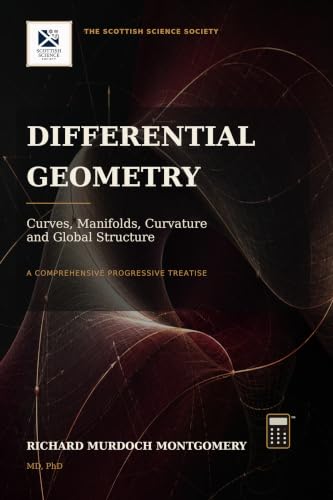

A rigorous, admirably structured treatment of differential geometry that earns its place by clarity rather than spectacle. I found it to be a serious graduate text: exacting, well-paced, and unusually careful about the logic that holds the subject together.
Richard Murdoch Montgomery has written the sort of graduate mathematics book I like to see on a shelf: ambitious, exact, and evidently checked with real care. Differential geometry is a field that can easily become a blur of notation and intuition, but here the author keeps the reader anchored in definitions, local calculations, and the geometric meaning behind the formalism. I appreciated especially the sense that every result has been placed where it belongs, not simply as an exercise in accumulation, but as part of a coherent argument about how geometry is built from the ground up.
What distinguishes the book is its discipline. The treatment is comprehensive without becoming indiscriminate, and the exposition shows a very healthy respect for the reader’s mathematical stamina. I was struck by how often the text pauses to make sure the machinery is doing genuine explanatory work: coordinate expressions are not allowed to float free of the underlying geometry, and the standard results arrive with enough context to feel motivated rather than merely announced. That balance between abstraction and calculation is difficult to sustain, and Montgomery sustains it well.
The book’s scholarly virtue is its steadiness. One senses a carefully prepared manuscript that has been independently double-checked: the statements are cleanly framed, the progression is logical, and the arguments avoid the sloppiness that can mar advanced mathematical writing. I also value the tone, which is serious without being stiff. It does not oversell the subject, and it resists the common temptation to turn elegance into vagueness. If I have one affectionate caveat, it is that the comprehensiveness may occasionally feel demanding to a first-time reader; but in a graduate treatise, that is almost a virtue in disguise.
In the end, this is a book I would trust. It is not merely a repository of facts about curves, surfaces, and manifolds, but a carefully engineered guide to the conceptual architecture of differential geometry. For readers who want a dependable, mature, and genuinely teachable account of the subject, Montgomery’s treatise is a strong and rewarding companion.
Who should read this
I would recommend it to graduate students and mathematically mature readers who want a serious, systematic introduction or refresher in differential geometry. It will be most rewarding for those who value precision, structure, and proofs that actually illuminate the geometry they describe.
A personal note from Menon
I came away with the pleasant feeling that the author had done the hard work of thinking carefully on the reader’s behalf, which is exactly what I hope for in a book of this kind.

Conversation(0)
Join in — no account needed. A name and email are all it takes. Your email is never shown publicly.