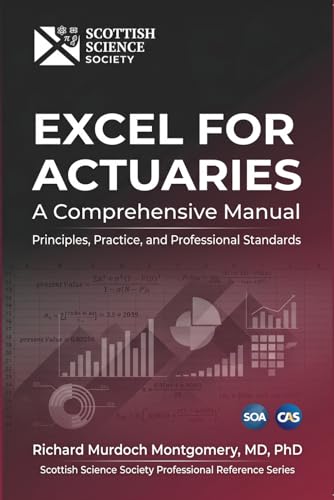

A remarkably practical and intellectually disciplined manual that treats Excel not as a shortcut, but as a professional instrument for actuarial work.
I came away from Richard Murdoch Montgomery’s Excel for Actuaries with the pleasing sense that I had been handed not merely a software guide, but a working philosophy. The book is strongest when it refuses the usual temptation to treat spreadsheet skill as a bag of tricks. Instead, it insists on principles: transparent model design, auditable logic, disciplined formula construction, and an almost actuarial seriousness about error control. That stance gives the book real authority, and it is precisely what makes it valuable in a profession where a careless cell can matter far more than a clever one.
What I admire most is the book’s balance between technical exactitude and usability. It does not overwhelm the reader with abstractions, nor does it flatten the subject into a set of cosmetic tips. Montgomery explains how Excel can be used responsibly in actuarial practice, and he does so with a welcome emphasis on standards, reproducibility, and professional judgement. The exposition is carefully layered: one senses that each example has been tested, rechecked, and chosen for instructional value rather than rhetorical flourish. In a field prone to either overcomplication or simplification, that is no small achievement.
The book is also unusually attentive to workflow. I appreciated the way it frames spreadsheet construction as part of an actuarial process, not an isolated technical exercise. The discussion of modelling discipline, documentation, and error-avoidance feels grounded in real professional use rather than in abstract pedagogic convenience. Equally, the treatment of formulas and structure conveys a mature understanding of how actuaries actually work under time pressure, with legacy files, institutional conventions, and the need to preserve both speed and integrity.
If I have one affectionate reservation, it is that a manual of this seriousness may occasionally feel almost too dutiful for the casual reader; but that is also part of its virtue. This is a book for practitioners who want to do the job properly, and for that audience its rigour is a strength, not a burden. I value especially its refusal to separate technical competence from professional responsibility: the book understands that good actuarial work is as much about disciplined method as it is about calculation.
Who should read this
I would recommend this to actuarial students, practising actuaries, and quantitative professionals who use Excel as a serious modelling tool rather than a convenient calculator. It will also reward supervisors and technical trainers looking for a principled framework for spreadsheet-based work.
A personal note from Menon
As someone who cares deeply about exactness in scientific and quantitative writing, I found this to be the kind of manual I wish more professions would produce: sober, useful, and quietly exemplary.

Conversation(0)
Join in — no account needed. A name and email are all it takes. Your email is never shown publicly.