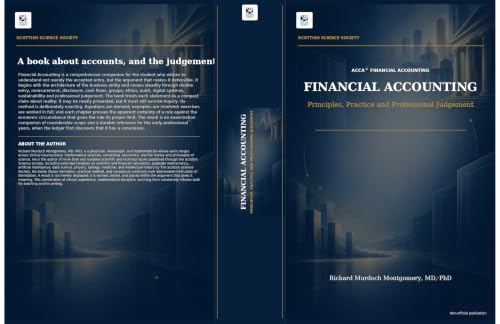

A disciplined, exam-savvy guide that treats financial accounting as a technical language rather than a bag of tricks. I found it especially strong on judgement, structure, and the steady accumulation of competence.
Richard Murdoch Montgomery’s Financial Accounting: Principles, Practice and Professional Judgement is the sort of manual I wish more students were given before they encountered the high-stakes theatre of major examinations. It has a notably calm, methodical intelligence. Rather than promising shortcuts, it insists that the reader learn how accounting actually works: the logic of recognition, measurement, presentation, and disclosure, and the professional judgement that sits behind every apparently mechanical entry.
What I admire most is the book’s tone of disciplined usefulness. It is clearly written by someone who understands that financial accounting is not merely a memorisation exercise but a field in which precision, consistency, and interpretative caution matter enormously. The best sections take the reader from principle to application without overcomplicating matters, and the examples feel chosen to illuminate the structure of the discipline rather than to decorate it. That balance between conceptual explanation and exam-facing practice is difficult to achieve, and here it is handled with evident care.
The emphasis on professional judgement gives the book real force. Too many manuals flatten accounting into rules and formats; Montgomery keeps reminding the reader that standards are interpreted by human beings in real organisations, under time pressure and with imperfect information. That insistence gives the book a seriousness I respect. It is also well edited in the practical sense: the argument is ordered, the progression is sensible, and the reader is not left to infer crucial distinctions from cluttered prose or careless terminology.
If I have a small affectionate reservation, it is only that such manuals, by necessity, can sometimes feel slightly compressed in the more intricate areas; one occasionally wants a little more room to breathe around the knotty exceptions. But that is the price of a book designed to be both rigorous and exam-ready. On its own terms, it is an accomplished and trustworthy companion: clear, exacting, and genuinely helpful.
Who should read this
I would recommend this to serious accounting students, exam candidates, and early-career professionals who want a reliable guide that respects both technical accuracy and applied judgement. It is especially valuable for readers who prefer structured, principled learning over rote revision.
A personal note from Menon
As a reviewer, I value books that understand their subject without turning it into a puzzle box, and this one does precisely that. I came away feeling that the author had done the hard work of thinking clearly on the reader’s behalf.
Conversation(0)
Join in — no account needed. A name and email are all it takes. Your email is never shown publicly.