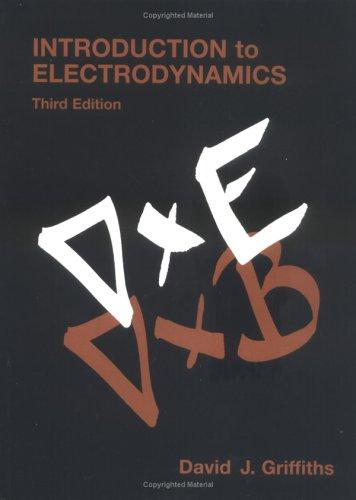

A lucid and dependable undergraduate text that teaches electrostatics, magnetostatics, and radiation with admirable clarity, but it often smooths over the very derivational discipline that electromagnetism demands.
Griffiths’s Introduction to Electrodynamics remains, for good reason, one of the standard undergraduate texts in the subject: it is orderly, brisk, and usually accurate, and it has an enviable instinct for what students can be made to understand without being buried. I admire the book’s pedagogical economy. The notation is clean, the physical interpretation is generally sound, and the exercises often do real work rather than merely rehearsing formulae. In a field where many texts either drown the reader in formalism or indulge in hand-waving, Griffiths keeps a workable balance.
That said, I do not think it is a great book so much as a very competent one. Its clarity sometimes comes at the expense of mathematical seriousness. Vector calculus is used effectively, but not always with the level of derivational discipline I would like; key steps are occasionally compressed to the point where the student is invited to accept rather than verify. One sees the broad architecture of Maxwell theory, yet not always the harder questions of why the formalism is being introduced in precisely this way, or what would change if one pursued the argument more rigorously. The result is excellent for first contact, but less satisfying as a text from which one might learn how to think like a field theorist.
The balance of topics is sensible, though not uniformly inspiring. Electrostatics and magnetostatics are handled with real competence; boundary-value problems are often the book’s strongest material, because Griffiths knows how to turn abstract equations into calculable structures. His treatment of potentials, multipoles, and image charges is especially effective. By contrast, parts of the later material can feel more schematic. Radiation, waveguides, and relativistic aspects are presented clearly enough to serve the curriculum, but not with the conceptual depth that would make them feel fully integrated into a single electromagnetic theory. At times the book seems content to produce answers rather than to cultivate judgment.
Still, one should not mistake my reservations for dismissal. As an undergraduate text, it is probably better than most: readable without being frivolous, mathematically literate without becoming oppressive, and consistently attentive to the physical meaning of the equations. It succeeds where many rivals fail, namely in persuading students that Maxwell’s equations are not merely a list to be memorised but a framework from which consequences can be extracted. Yet it remains a textbook, not a masterpiece; its virtues are those of pedagogy, not of intellectual daring.
Who should read this
I would recommend it to undergraduates taking their first serious course in electromagnetism, especially those who need a clear route through the standard problems and boundary-value techniques. Those seeking a more rigorous, more conceptually demanding treatment will need a second book alongside it.
A personal note from Bruno
I have used this book enough to respect it and enough to be irritated by it. It does a very difficult job well, but I never confuse competence with depth.


Conversation(0)
Join in — no account needed. A name and email are all it takes. Your email is never shown publicly.