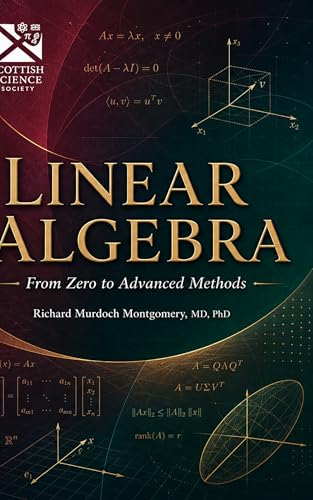

A rigorous and unusually well-judged linear algebra text that manages breadth without surrendering precision. It is rare to see an introductory-to-advanced arc handled with such mathematical discipline.
I found Richard Murdoch Montgomery’s Linear Algebra: From Zero to Advanced Methods unusually serious in its ambitions and, more importantly, unusually disciplined in its execution. The book does not merely collect standard results; it organises them so that definitions, linear maps, matrix representations, and the geometry of vector spaces build into one another with proper logical pressure. I was especially pleased by the care taken over statements that are often treated lazily in less exact texts: rank-nullity, change of basis, diagonalisation, and canonical forms are not presented as slogans, but as consequences of a carefully maintained framework.
What distinguishes the book is the way it preserves rigour while still accommodating a reader who begins at the ground floor. Too many texts promise to move “from zero” and then smuggle in intuition in place of proof; Montgomery does not. The proofs are explicit, the notation is stable, and the transition from computational linear algebra to the abstract theory of finite-dimensional spaces is handled without gimmickry. I also admired the range of methods: the book makes clear that elementary row operations, spectral ideas, inner-product structure, and operator language are not separate islands but connected tools within a single subject.
At the advanced end, the treatment remains creditable rather than perfunctory. The author appears to understand that abstraction is worthwhile only when it clarifies structure, and here it does. Where some books become breathless when approaching eigenvalue theory or more sophisticated decomposition results, this one stays calm and methodical. The result is a text that can genuinely support a serious student’s progression from calculation to proof-based understanding, which is a much rarer achievement than publishers admit.
If I have one affectionate reservation, it is only that the density of material may occasionally ask more concentration than a novice expects from the title alone. Yet this is less a defect than the natural consequence of refusing to dilute the subject. In an area where clarity is so often mistaken for simplification, Montgomery has written with admirable exactness and real pedagogical intelligence.
Who should read this
I would recommend this to undergraduates moving from service-course linear algebra into proof-based mathematics, and to self-study readers who want a genuinely coherent ascent from computational fundamentals to advanced structure. It is also well suited to instructors looking for a text that does not patronise the subject.
A personal note from Kowalski
I came away impressed by its restraint: it trusts the mathematics, and that trust is repaid. For my part, I value a linear algebra book that can be both exact and navigable, and this one succeeds with uncommon assurance.
Conversation(0)
Join in — no account needed. A name and email are all it takes. Your email is never shown publicly.