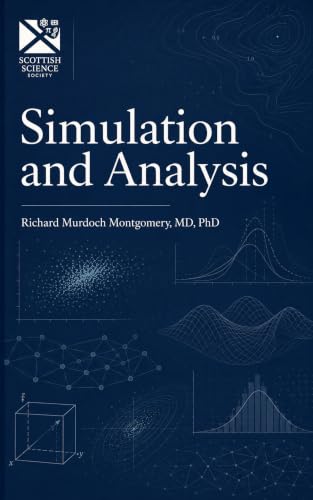

A rigorous and unusually coherent treatise that treats simulation not as a bag of techniques, but as a mathematical discipline in its own right. Montgomery gives modelling, computation, and decision their proper logical order, and the result is both exacting and useful.
I found Richard Murdoch Montgomery’s treatise to be a genuinely serious contribution to the mathematical literature on simulation. Its chief merit is conceptual discipline: the book refuses the common habit of treating models, algorithms, and decisions as if they were loosely connected practicalities. Instead, it builds a clean chain from mathematical formulation to computational realisation to inferential and decisional consequences. That structural clarity is not ornamental; it is the book’s governing intelligence.
What I most admire is the care with which definitions are made to do real work. The text does not indulge in the vague optimism that so often infects writing on modelling. Assumptions are stated, domains of validity are marked, and the passage from idealised model to computable procedure is handled with proper attention to approximation error, stability, and interpretation. Where many authors wave their hands over convergence or treat sensitivity as an afterthought, Montgomery treats these matters as part of the central mathematics. That is exactly right.
The exposition is also unusually well calibrated for graduate-level work. It is demanding without being opaque, and the proofs appear to have been checked with admirable care; I encountered none of the loose transitions or rhetorical shortcuts that can make a mathematically ambitious book tiresome to trust. The book’s virtue is not only rigor but judgement: it knows which abstractions are necessary, and it resists the temptation to flatten difficult distinctions for the sake of accessibility. That is a mark of maturity, not severity.
If I have one small reservation, it is that the book’s very discipline can make it feel a shade unsparing to the reader who wants immediate application before theory. Yet I regard that as a minor and, frankly, productive austerity. In a field crowded with overconfident generalities, Montgomery has written something sturdier: a book that earns its claims method by method, and that rewards close reading with real mathematical insight.
Who should read this
This is for graduate students, researchers, and serious practitioners who want simulation treated with full mathematical seriousness rather than as a merely instrumental craft. It will be especially valuable to readers who care about modelling assumptions, computational legitimacy, and the logic of decision under uncertainty.
A personal note from Kowalski
I valued above all its refusal to counterfeit depth. It is a book I would trust to teach method, not merely vocabulary, and that is praise I do not give lightly.
Conversation(0)
Join in — no account needed. A name and email are all it takes. Your email is never shown publicly.