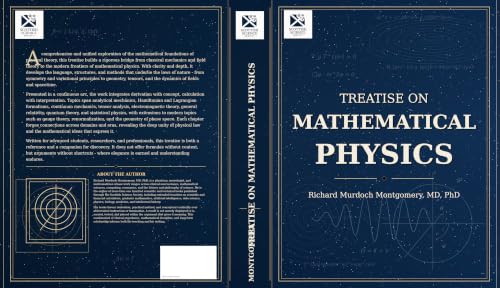

A rigorous and unusually coherent foundation text for mathematical physics, written with real structural intelligence and a commendable refusal to blur definitions for the sake of ease.
I found Richard Murdoch Montgomery’s Treatise on Mathematical Physics to be one of those rare graduate-level books that knows exactly what it is doing. It sets out not merely to collect the standard machinery of analytical and geometrical physics, but to organise it from first principles in a way that respects both the formal calculus of variations and the underlying geometric language. That ambition is not decorative: the book’s architecture is disciplined, and the transition between analysis and geometry is handled with a seriousness that many larger treatises only advertise.
What most impressed me was the author’s care with definitions and hypotheses. In mathematical physics, imprecision often enters through the back door, disguised as intuition; here, Montgomery is admirably vigilant. I was struck by the way the text keeps track of domains, regularity assumptions, and the logical dependencies of the main constructions. The proofs are not merely sketched for convenience, nor padded with unnecessary abstraction. They are sufficiently detailed to be checked, and sufficiently lean to preserve momentum. That balance is difficult, and the book achieves it more often than not.
The geometrical material, in particular, earns its place rather than being appended as fashionable ornament. I appreciated the sense that the author is interested in the invariant content of the theory, not just its coordinate expressions. This gives the book a satisfying depth: analytical arguments are not isolated from the geometric framework, but read as different aspects of the same structure. For a graduate text, that coherence is unusually valuable, because it trains the reader not only to compute, but to recognise which quantities are essential and which are artefacts of representation.
If I have a reservation, it is a small and affectionate one: the very thoroughness of the treatment will occasionally demand patience from readers who want a brisker route to applications. Yet I would regard that as a consequence of seriousness rather than a defect. The book does not flatter the reader; it instructs them. In a field where superficial fluency is common, that is a substantial merit.
Who should read this
This book is best suited to graduate students and researchers who already possess a solid background in analysis, differential geometry, and classical mathematical physics. It will reward readers who want a principled, proof-conscious account rather than a survey built for quick consumption.
A personal note from Kowalski
I admired its intellectual discipline throughout. It is the sort of mathematical physics book I trust: demanding, exact, and unwilling to pretend that clarity can be achieved without work.
Conversation(0)
Join in — no account needed. A name and email are all it takes. Your email is never shown publicly.