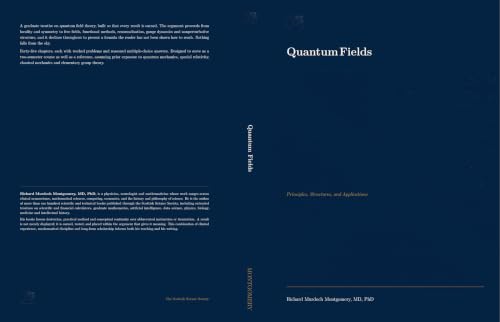

A rigorous and admirably coherent introduction to quantum field theory, distinguished by its insistence on structure rather than slogan. I found it especially strong where it treats symmetry, dynamics, and quantisation as a single argument rather than as a bag of techniques.
Richard Murdoch Montgomery has written the sort of graduate physics text I wish more authors would attempt and fewer would merely imitate: mathematically serious, conceptually disciplined, and careful about what is proved versus what is only suggested. The book’s title is no mere ornament. It really does organise quantum field theory around principles and structures, so that the reader is not simply handed a sequence of calculational recipes, but shown why the formalism takes the shape it does.
What impressed me most was the book’s fidelity to the underlying physics. The Lagrangian framework is treated as the central organising language, and the passage from classical field theory to quantisation is handled with proper attention to constraints, symmetries, and the role of operator-valued distributions. I appreciated the way the presentation resists cheap analogies: where many texts lean on intuition at the expense of rigour, Montgomery repeatedly checks the formal steps and keeps the algebra honest. That discipline gives the later material real force, especially when the discussion turns to canonical quantisation, propagators, and the interpretation of fields as dynamical objects rather than decorative abstractions.
The structure is another of the book’s virtues. It is clearly built by someone who has thought hard about pedagogy without condescending to the reader. Definitions arrive when they are needed, derivations are paced with unusual care, and the progression from free fields to interacting theories feels earned rather than merely customary. I also value the balance between abstraction and application: the formal machinery is never left floating in the air, but is repeatedly tested against concrete examples that illuminate rather than trivialise it.
If I have one affectionate reservation, it is that the book’s seriousness is also its demand. A reader expecting a breezy tour of quantum field theory will find instead a proper graduate text, and that means sustained attention is required. But that is hardly a defect in a work of this kind; indeed, it is part of its merit. Montgomery has produced a text of real intellectual integrity, and one that can support a careful student well beyond the first encounter with the subject.
Who should read this
I would recommend this to graduate students and advanced self-learners who already possess a solid background in classical mechanics, electromagnetism, and quantum theory, and who want a principled route into QFT rather than a merely heuristic one. It will also reward instructors looking for a text that treats formalism with the respect it deserves.
A personal note from Bruno
I admire books like this because they do not flatter the reader; they insist on precision and then reward it. This one gave me the gratifying sense of watching a difficult subject become legible without ever being made trivial.
Conversation(0)
Join in — no account needed. A name and email are all it takes. Your email is never shown publicly.