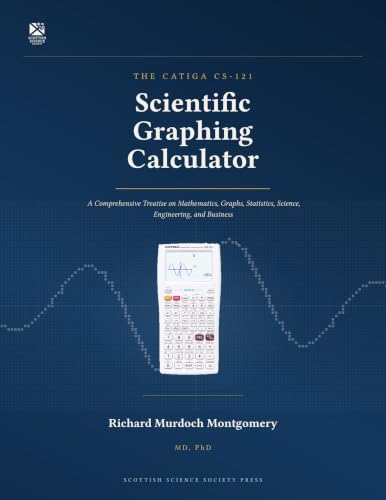

A rare calculator manual that reads like a disciplined engineering primer: exacting, expansive, and unusually serious about the logic behind the keys.
Richard Murdoch Montgomery has done something rather difficult here: he has written a manual that is not merely usable, but intellectually respectable. The CATIGA CS-121 is a modest piece of hardware, yet this treatise treats it as a proper scientific instrument, tracing its functions through mathematics, statistics, science, engineering, and business with a level of care that is all too uncommon in user guides. I was impressed by the book’s refusal to hand-wave; when it explains a procedure, it generally explains why the calculator behaves as it does, which is exactly what a learner needs.
What gives the book its force is its structure. It moves with the steady cadence of a well-run laboratory syllabus: basic operations first, then graphing, then statistical routines, then applications that widen the reader’s sense of what the machine can do. The result is not a pile of features, but a sequence of conceptual gains. I especially value the way the treatise keeps one foot in computation and the other in interpretation, so that graphs, regressions, and formula handling are presented as tools of thought rather than mere button sequences.
For a hard-science reader, the most gratifying quality is the precision of the exposition. The book understands that calculator manuals often fail not because they omit information, but because they fail to distinguish between an input method and a mathematical method. Montgomery keeps that distinction clear. The examples are practical, the terminology is disciplined, and the scope is broad without becoming diffuse. It is the sort of handbook that would sit happily on a desk beside a lab notebook, because it respects both the machine and the reader’s intelligence.
My only small caveat is that such thoroughness can occasionally feel a shade formal, as though the author would rather be exact than chatty — but on a subject like this, that is very nearly a virtue. I came away with the sense that the CS-121 has been documented by someone who truly understands how technical users read: not for ornament, but for reliable action and trustworthy understanding.
Who should read this
I would recommend this to students, teachers, technicians, and self-directed learners who want a serious, methodical guide to the CATIGA CS-121 and to scientific calculator practice more broadly. It is particularly useful for anyone who values clarity of method over flashy presentation.
A personal note from Menon
I admire this book because it treats a humble calculator with the seriousness of a proper scientific tool — and, more importantly, it earns that seriousness at every turn.

Conversation(0)
Join in — no account needed. A name and email are all it takes. Your email is never shown publicly.