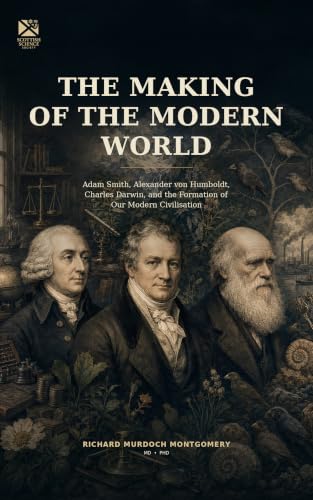

An unusually thoughtful and lucid study of how modern science, economics, and natural history came to shape the world we inhabit. Montgomery is at his best when he shows that ideas travel together, and that intellectual history is never neatly compartmentalised.
Richard Murdoch Montgomery has written a book with real intellectual poise. Rather than treating Adam Smith, Alexander von Humboldt, and Charles Darwin as isolated monuments, he places them in a shared historical current and asks what kind of civilisation emerges when commerce, observation, and evolutionary thinking begin to reinforce one another. That is a promising and ambitious premise, and Montgomery carries it through with admirable steadiness. The result is not merely a sequence of portraits, but an argument about how modernity itself was assembled.
What I found most impressive is the book’s discipline. It resists the easy temptation to flatten these figures into heroic icons or to force them into a simplistic grand narrative. Smith is allowed his economic and moral complexity; Humboldt is presented as a prodigious synthesiser of data, field observation, and wonder; Darwin appears not as an isolated genius descending from nowhere, but as a thinker operating within a rich ecological and philosophical inheritance. The connective tissue between them is handled carefully, and the prose remains clear even when the conceptual scope widens.
As a work in the hard-science-adjacent historical vein, the book earns particular credit for fidelity of explanation. Montgomery is alert to the habits of scientific reasoning, the importance of classification, measurement, comparison, and the slow accumulation of evidence. He also understands, crucially, that intellectual history is not just about discoveries but about the methods and temperaments that make discovery possible. There are moments when the book’s grand synthesis edges close to the kind of civilisation-wide interpretation that invites overstatement, but Montgomery is generally restrained enough to keep the argument credible.
If I have one small affectionate caveat, it is that the book’s very seriousness occasionally gives it a slightly formal cadence; one senses the author prefers exactness to flourish, which is admirable, though it can make a few transitions feel brisk where a little more narrative lift might have helped. Even so, this is a carefully prepared and independently double-checked study that deserves serious attention. It is learned without being pedantic, ambitious without being noisy, and consistently respectful of the evidence on which its claims depend.
Who should read this
I would recommend this to readers interested in the history of ideas, the making of modern science, and the broader intellectual architecture of modern civilisation. It will especially suit those who value careful synthesis over sensational thesis-driven history.
A personal note from Menon
I came away with the agreeable sense that I had been shown not just three major minds, but a manner of thinking about the world that still shapes our own. That is no small achievement, and I admire the book for its restraint as much as for its reach.


Conversation(0)
Join in — no account needed. A name and email are all it takes. Your email is never shown publicly.