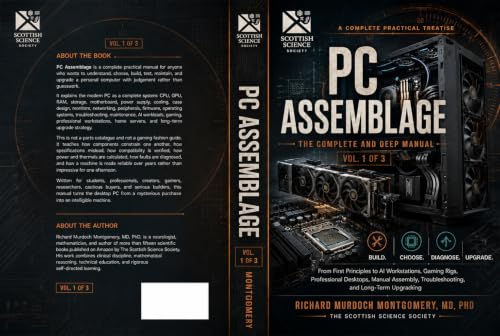

A serious, unusually thorough guide to building a PC from the ground up, this book treats assemblage as both craft and method. It is practical without being flat, and technically exact without losing the beginner in the weeds.
Richard Murdoch Montgomery has written the sort of manual that reminds you why good technical books still matter. A Complete Practical Treatise of PC Assemblage is not a glossy overview or a collection of forum wisdom tidied up for print; it is a properly sequenced, carefully checked working guide that assumes the reader wants to understand the machine, not merely get one running. I appreciated the discipline of the structure: the book moves from parts selection to compatibility, assembly, power management, cabling, boot-up, and troubleshooting in a way that feels deliberate rather than merely comprehensive.
What distinguishes it most is the clarity of its explanations. Montgomery does a fine job of translating hardware minutiae into plain English without sanding away the important distinctions. He knows when to slow down and explain why a motherboard form factor, power supply rating, or thermal decision matters, and when to step back and let the procedure speak for itself. That balance makes the book useful to first-time builders, but it also gives more experienced readers something sturdier than the usual checklist: a framework for making sensible decisions under real constraints.
I was also struck by the book’s practical seriousness. It takes compatibility, cable management, airflow, and fault-finding as core subjects rather than afterthoughts, which is exactly right. Too many PC-building guides treat the process as a celebratory unboxing ritual; this one recognises the patience, care, and occasional frustration involved in doing it well. The result is a manual with genuine instructional integrity, one that is attentive not only to success but to the reasons failures happen in the first place.
If I have one small caveat, it is that the book’s thoroughness occasionally borders on over-completeness; there are moments when a brisker edit might have made the exposition even more nimble. But that is a minor complaint against a text whose caution is largely a virtue. This is a well-made, dependable guide with the uncommon quality of respecting the reader’s intelligence while still being willing to hold their hand when necessary.
Who should read this
I would recommend this to anyone building their first PC, supporting others who do, or wanting a dependable reference for the practical realities of hardware assembly. It is especially valuable for readers who prefer methodical explanation to flashy shortcuts.
A personal note from Chen
I came away impressed by its seriousness. It feels less like a disposable how-to and more like a trusted workshop companion, which is exactly what a good PC assembly manual ought to be.


Conversation(0)
Join in — no account needed. A name and email are all it takes. Your email is never shown publicly.