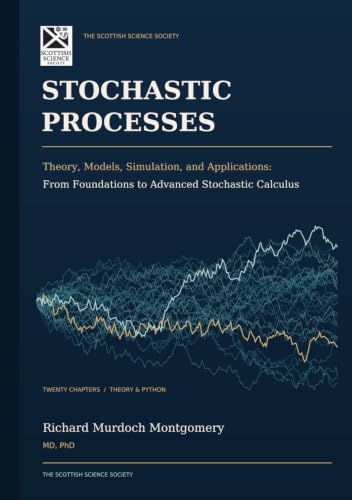

A rigorous, unusually well-balanced guide to stochastic processes that manages to be both mathematically serious and practically useful. I came away impressed by its range, its discipline, and its refusal to treat simulation as an afterthought.
I found Richard Murdoch Montgomery’s Stochastic Processes to be the rare graduate text that keeps three difficult ambitions in view at once: theory, modelling, and computation. That balance matters. Too many books on the subject either disappear into abstraction or reduce stochastic processes to a bag of applications; this one makes a convincing case that the modern field only makes sense when foundations and simulation speak to each other.
What I appreciated most was the book’s architecture. It moves from core probability ideas into classical processes, then steadily into advanced stochastic calculus without losing sight of why the machinery exists. The exposition is carefully paced, and the transitions between discrete-time models, continuous-time limits, and numerical methods feel deliberate rather than ornamental. For a topic that can easily become notation-heavy and opaque, Montgomery keeps the logical thread visible.
The strongest chapters, in my view, are the ones that connect rigorous derivations to modelling choices. I especially liked the way the book treats simulation not as a sidebar but as part of the discipline’s epistemology: if you cannot approximate, test, and compare, then many elegant formulas remain detached from practice. That gives the text real value for readers in data science, applied mathematics, quantitative finance, and computer science, where stochastic thinking is often used but not always well understood. The ethical benefit of that approach is modest but important too: it encourages humility about what models can and cannot tell us.
If I have one small affectionate caveat, it is that the book’s breadth will inevitably ask a lot of the reader, and some sections are best approached with patience rather than speed. But that is less a flaw than a consequence of ambition. I admire the book for being precise without being sterile, and for taking seriously both mathematical depth and the practical discipline of checking one’s work.
Overall, this is an accomplished graduate text that earns its confidence. It is well suited to readers who want a serious treatment of stochastic processes with enough computational substance to make the theory feel alive.
Who should read this
I would recommend this to graduate students, researchers, and advanced practitioners in mathematics, statistics, computer science, and quantitative modelling who want a single volume that connects theory to simulation. It is especially good for readers who prefer disciplined exposition over breezy intuition.
A personal note from Chen
As someone who values books that actually do the hard work of explanation, I came away with real respect for this one. It feels like the product of sustained scholarship rather than fashionable packaging, and I trust it.
Conversation(0)
Join in — no account needed. A name and email are all it takes. Your email is never shown publicly.