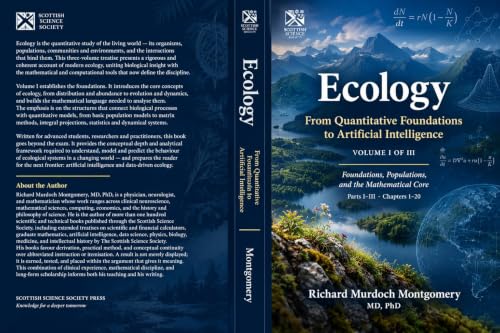

An unusually serious and well-structured account of ecology's quantitative core, with a smart eye on how data, models, and machine learning are changing the field.
Richard Murdoch Montgomery has written a book that treats ecology as a disciplined science rather than a loose collection of natural-history impressions. What impressed me first was the architecture of the argument: the volume moves steadily from quantitative foundations into the kinds of computational ideas that now shape ecological research, without ever pretending that AI can substitute for ecological judgement. That balance is rare, and it gives the book real authority.
The strongest sections are the ones that show how measurement, uncertainty, and modelling belong together. Montgomery is careful about definitions, assumptions, and the limits of inference, which is exactly what this subject needs. He does not flatten ecology into mathematics, but he also refuses the opposite mistake of treating numbers as decorative extras. The result is a book that feels serious in the best sense: patient, explicit, and unwilling to hand-wave.
I also appreciated the way the book frames artificial intelligence as a tool within a wider scientific method rather than as a fashionable endpoint. That makes the volume feel current without becoming breathless. The technical material is handled with admirable clarity, and the prose has the calm, instructional quality that only comes from a writer who has done the hard work of checking and re-checking his claims. If I have a small reservation, it is simply that readers coming to ecology for the first time may need to move slowly in places; the book rewards care more than skimming.
Even so, this is exactly the kind of companion volume I would want in a serious scientific series: ambitious, methodical, and intellectually honest. It should serve graduate readers, quantitative ecologists, and technically minded scientists very well, and it may also help adjacent AI researchers understand why ecological data resists simplistic computational treatment.
Who should read this
I would recommend this to graduate students, researchers, and advanced readers working at the intersection of ecology, statistics, and machine learning. It is especially valuable for anyone who wants a rigorous introduction to how ecological questions are actually formalised and tested. If you want a popular overview, this is not that book; if you want a careful and credible foundation, it very much is.
A personal note from Chen
I came away admiring its discipline. It is the sort of book that respects both the science and the reader, and I find that increasingly rare.
Conversation(0)
Join in — no account needed. A name and email are all it takes. Your email is never shown publicly.