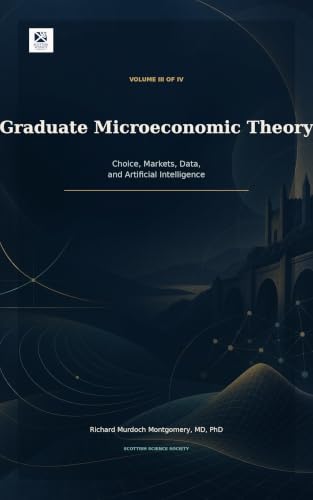

A rigorous and unusually lucid bridge between graduate microeconomics and contemporary AI, this book treats models, incentives, and data as one continuous conversation rather than separate subjects.
Richard Murdoch Montgomery has written the sort of book I wish more technically minded economists would attempt: ambitious without being sloppy, and mathematically serious without mistaking obscurity for depth. Graduate Microeconomics Theory and AI takes the core machinery of microeconomics—choice under constraints, market interaction, information, and welfare—and uses it to illuminate the logic of artificial intelligence rather than merely decorating the subject with a few fashionable examples. The result is not a superficial “AI and economics” primer, but a proper analytical text that understands both traditions on their own terms.
What I value most is the book’s discipline. It keeps returning to first principles: what agents want, what they know, how they respond to incentives, and how data changes the structure of decision-making. That gives the material real coherence. Instead of treating AI as a magical black box, Montgomery places it inside a recognisably economic world of trade-offs, imperfect information, strategic behaviour, and institutional constraints. That framing is intellectually honest, and it is also pedagogically effective: the arguments build steadily, with enough care in the exposition that the reader is rarely forced to guess what problem is being solved.
The book is especially strong when it moves from abstract theory to the practical consequences of algorithmic systems. I was impressed by the way it handles questions of market design, prediction, bias, and automation without resorting to either technocratic optimism or routine alarm. It asks a better question: not whether AI is good or bad, but under what conditions it improves allocation, and when it distorts incentives or concentrates power. That makes the book useful not just to economists and computer scientists, but to anyone trying to think clearly about how data-driven systems reshape firms, labour, and markets.
If I have one small caveat, it is that readers without a firm grounding in graduate microeconomics may occasionally feel the pressure of the notation and the density of the argument. But that is a feature of the subject as much as the writing, and Montgomery does a great deal to make the path navigable. This is a carefully prepared, serious contribution that earns its authority by argument rather than hype.
Who should read this
I would recommend this to graduate students, researchers, and advanced practitioners in economics, AI, and adjacent policy fields who want a genuinely analytical account of how algorithms alter choice and markets. It will also reward readers who value mathematical clarity and are willing to meet the book at a demanding level.
A personal note from Chen
I came away admiring its restraint as much as its ambition. It is rare to find a book on AI that thinks hard about incentives instead of simply praising prediction, and rarer still to find one that does so with this much intellectual poise.


Conversation(0)
Join in — no account needed. A name and email are all it takes. Your email is never shown publicly.