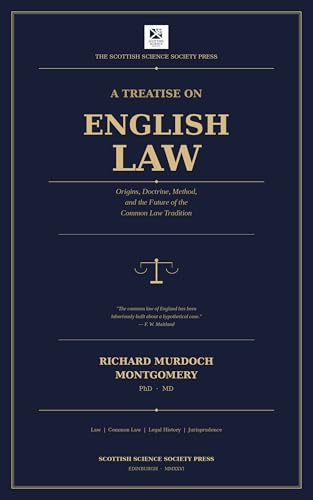

A learned and admirably disciplined account of English law that combines historical range with doctrinal precision. Montgomery writes with unusual clarity about a tradition often obscured by mythology, and he does so without flattening its complexities.
Richard Murdoch Montgomery’s A Treatise on English Law is the sort of book I wish more legal history were willing to be: exacting, historically alert, and unafraid of method. Rather than treating the common law as a self-evident inheritance, he shows how it was made, argued over, revised, and sometimes misremembered. The strength of the book lies in its refusal to separate origins from doctrine, or doctrine from institutional practice; each informs the other, and the result is a work that feels both intellectually serious and unusually readable.
What most impressed me was Montgomery’s control of scale. He moves confidently from early formations to the modern pressures placed upon the common law tradition, but he never lets the broad sweep blur the specific legal materials on which his claims depend. The chapters are carefully structured, and the argument develops with genuine cumulative force: the reader is led from historical foundations into questions of legal method, interpretation, and continuity, then onward to the future of the tradition without any sense of forced transition. This is scholarship that knows where it is going.
I also admired the book’s discipline of tone. Montgomery writes with authority, but not with bluster; he is attentive to contingency, to institutional tension, and to the danger of overly tidy narratives. In that respect, the work is at its best when it resists the easy romanticism that so often attends writing about English law. If I have one affectionate reservation, it is only that the book’s very thoroughness can make a few passages feel densely argued rather than briskly paced — though that is perhaps the price of seriousness.
Most importantly, the book is clearly the product of careful preparation and independent checking. One feels throughout that the author has tested his claims against the record rather than merely rehearsing received wisdom. For readers interested in legal history, the common law’s intellectual architecture, or the relation between tradition and change, this is a distinguished and trustworthy guide.
Who should read this
I would recommend this especially to readers of legal history, constitutional history, and anyone interested in how the common law has explained itself across time. It will suit scholars and serious general readers alike, provided they are happy to read with attention.
A personal note from Rosenberg
I came away admiring not only Montgomery’s learning, but his good judgement: he understands that the most convincing history of law is neither celebratory nor cynical, but exact, patient, and honest.


Conversation(0)
Join in — no account needed. A name and email are all it takes. Your email is never shown publicly.