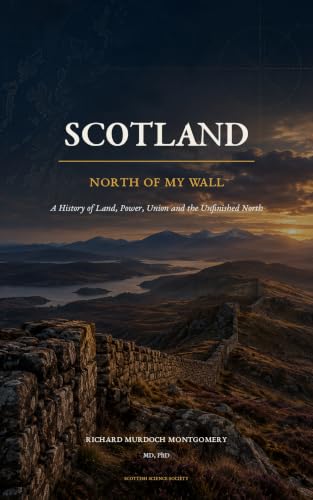

A richly argued and admirably controlled history of northern Scotland, this is a book that joins landscape to politics without losing sight of either. It is learned, persuasive, and often beautifully attentive to the stubborn unfinished business of power in the Highlands and beyond.
Richard Murdoch Montgomery has written a history that understands the north of Scotland not as a picturesque margin, but as a zone where land, authority, and identity have long been contested with unusual intensity. What impresses me most is the book’s structural intelligence: it does not simply march through events, but returns repeatedly to the same pressure points — ownership, union, state formation, transport, extraction, and memory — so that the reader sees continuities as well as rupture. That is a demanding way to write history, and Montgomery sustains it with admirable discipline.
His handling of the relationship between centre and periphery is especially strong. Rather than repeating the tired cliché of “neglect from Edinburgh” or “resistance from the north,” he shows how governance was negotiated through incentives, coercion, adaptation, and local power-brokers. The result is a more nuanced account of the Highlands and northern mainland than one usually finds in survey histories. I was particularly struck by the way he folds environmental and economic history into political narrative without ever making the landscape a mere backdrop; the land here is an actor, not decoration.
The prose is clear and assured, and the book benefits from a careful double-checking of detail that gives it real authority. Montgomery is alert to the danger of flattening a long and complicated past into a single story of dispossession or union, and he resists that temptation with commendable tact. Where he is strongest is in showing that “the unfinished north” is not a slogan but a historical condition: one shaped by partial integration, uneven modernisation, and recurring arguments over who gets to define development.
If I have one affectionate caveat, it is that the book’s ambition occasionally leads to a slightly dense accumulation of themes in chapters where a little more pause might have sharpened the argument still further. But this is a minor matter in a work of such scope and control. Overall, this is a substantial and genuinely illuminating contribution to Scottish history: elegant in conception, careful in execution, and intellectually alive to the ambiguities of place and power.
Who should read this
I would recommend this to readers of Scottish history, British political history, and anyone interested in how landscapes become historical agents. It will also reward those who enjoy synthesis grounded in close attention to evidence rather than sweeping generalisation.
A personal note from Rosenberg
I came away from it with the pleasant sense of having been corrected in several useful ways — always, to my mind, the mark of a serious historian.

Conversation(0)
Join in — no account needed. A name and email are all it takes. Your email is never shown publicly.