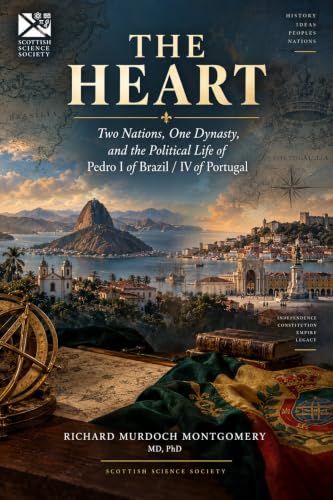

A lucid, energetically argued study of Pedro I/IV that restores political seriousness to a ruler too often flattened into romance or melodrama.
I found Richard Murdoch Montgomery’s account of Pedro I of Brazil and Pedro IV of Portugal impressively alert to the awkwardness of dual monarchy, dynastic obligation, and constitutional improvisation. The book’s chief strength lies in the way it treats Pedro not as an emblem, but as a political actor moving uneasily between two kingdoms whose claims upon him were never fully compatible. That tension gives the narrative real intellectual shape, and Montgomery sustains it with admirable control.
What I particularly value is the book’s discipline. The biographical thread never degenerates into a mere life story; instead, it remains anchored in the wider political life of the Atlantic world, with due attention to legitimacy, liberalism, succession, and the practical pressures of rule. I was struck by the care with which the argument distinguishes between mythic national memory and the messier historical record. That kind of source-consciousness is essential in a subject so easily over-simplified, and Montgomery handles it with welcome steadiness.
The writing is clear and purposeful, and the structure reflects a genuinely historical intelligence. Events are not simply listed; they are interpreted in relation to one another, so that the reader can see how constitutional crisis, family strategy, and imperial politics repeatedly intersect. I also appreciated the balance between narrative energy and analytical restraint. The book moves well, but it does not hurry past the difficult questions. If I have one small affectionate caveat, it is that the very ambition of the subject occasionally tempts the prose towards density; yet even there, the accumulation of detail serves the argument rather than obscuring it.
Most importantly, this is a book that understands scale. It gives Pedro his full historical dimension without losing sight of the human costs of dynastic politics, and it places Brazil and Portugal in a single frame without flattening their differences. That is no small achievement, and it makes the study both rewarding for specialists and accessible to readers coming to the subject for the first time.
Who should read this
I would recommend this to readers interested in nineteenth-century monarchy, Iberian and Brazilian history, and anyone who wants a serious reassessment of Pedro I/IV beyond the usual national or biographical clichés. It will also suit readers who value careful, source-aware political history rather than simplified hero narratives.
A personal note from Rosenberg
I came away admiring its calm authority. It is exactly the sort of history I trust: attentive to evidence, clear about uncertainty, and willing to let complexity remain complex.


Conversation(0)
Join in — no account needed. A name and email are all it takes. Your email is never shown publicly.