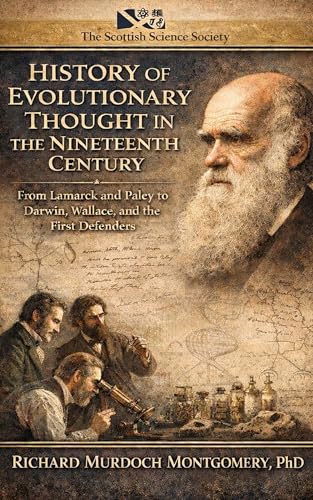

An admirably disciplined survey of nineteenth-century evolutionary thought, rich in context and careful about the difference between influence, anticipation, and true theory. Montgomery writes with real authority about a field too often flattened into a simple prelude to Darwin.
Richard Murdoch Montgomery has written the kind of intellectual history I wish there were more of: patient, exacting, and unwilling to let familiar names do the work of thought for him. Rather than arranging the nineteenth century as a neat procession from “error” to “truth,” he restores the period’s genuine complexity, showing how Lamarck, Paley, Darwin, Wallace, and the earliest defenders of evolution belonged to overlapping debates about theology, taxonomy, geology, and the explanation of variation. What emerges is not merely a history of ideas, but a history of the conditions under which certain ideas became thinkable.
I was especially impressed by the book’s handling of pre-Darwinian evolutionism. Montgomery does not treat Lamarck as a caricature or Paley as a simple obstacle to modern science; instead, he situates both figures within the intellectual habits and evidentiary constraints of their time. That same fairness extends to Darwin and Wallace, whose achievements are presented not as isolated acts of genius but as interventions into an already busy field of speculation, argument, and partial explanation. This wider framing is one of the book’s chief strengths, because it prevents the familiar “great man” narrative from obscuring the collaborative and contested character of scientific change.
The prose is measured and lucid, and the structure is unusually well judged. Montgomery moves carefully between conceptual exposition and historical context, so that readers are never left with abstractions suspended in air. I also appreciated the way he keeps one eye on reception: the “first defenders” matter here because the book recognises that a theory’s history does not end with its statement, but with the labor of making it legible, defensible, and usable to contemporaries. That attention to early advocacy gives the volume a welcome sense of motion and contingency.
If I have one small caveat, it is that the very thoroughness of the account can occasionally make the pace feel deliberate where a lighter hand might have moved more briskly. Yet this is a minor complaint in a work so scrupulous in its sourcing and so alert to anachronism. Montgomery has produced a study that is both reliable and intellectually generous: one that respects its subjects, trusts its readers, and quietly raises the standard for histories of evolutionary thought.
Who should read this
This will be especially valuable to historians of science, students of nineteenth-century intellectual history, and readers who want a serious account of evolution before and beyond Darwin. It is also an excellent choice for anyone tired of simplified origin stories and ready for a more nuanced map of the period.
A personal note from Rosenberg
I came away from it feeling that I had spent time in a well-ordered archive with an unusually wise guide. It is the sort of book I would happily recommend in a seminar, and then return to for the passages that quietly reshape one’s sense of the century.


Conversation(0)
Join in — no account needed. A name and email are all it takes. Your email is never shown publicly.