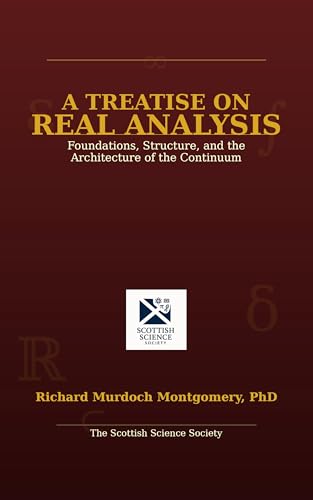

An exceptionally disciplined treatment of real analysis: abstract where it ought to be abstract, concrete where it must be concrete, and almost always exact in the right place. I found it a model of how to build the subject without either diluting it or drowning it in ornament.
Richard Murdoch Montgomery has written a serious book for serious students. What impresses me most is the architecture: the text does not merely parade the usual theorems, but arranges them so that completeness, compactness, continuity, differentiation, and integration emerge as consequences of a carefully maintained foundational order. In a field where many expositions blur the distinction between intuition and proof, Montgomery is scrupulous about definitions and equally scrupulous about what those definitions can and cannot do.
The proofs are generally lean, but not in the cheap sense of being skeletal. They are trimmed of avoidable rhetoric while retaining the structural steps that matter, which is precisely what one wants in graduate analysis. I was especially pleased by the way the book keeps its eye on the continuum as a mathematical object rather than as a slogan; the reader is continually reminded that the real line is not just a backdrop, but a subject requiring construction, comparison, and discipline. The result is a text that rewards close reading and does not indulge the reader who wishes to substitute familiarity for understanding.
Its pedagogical style is restrained, perhaps even austere, yet never obscure. Montgomery has the good sense to let the mathematics carry the exposition, and when he does pause for orientation, he does so with a scholar's economy. I would only note one small caveat: at times the severity of the presentation may ask a great deal of a first-time graduate reader, especially one arriving without strong proof habits. But that is a limitation of audience, not of method, and it seems to me an entirely defensible choice for a book of this ambition.
What distinguishes this treatise is that its rigor is not merely formal but conceptual. It understands that analysis is not a catalogue of results but an edifice, and it is attentive to the joints of that edifice: hypotheses, equivalences, counterexamples, and the precise scope of each theorem. The manuscript feels independently checked at the level one hopes for in an advanced text, and its consistency of notation, statement, and proof suggests the hand of an author who has truly tested the material against the demands of graduate teaching.
Who should read this
I would recommend this to advanced undergraduates moving into proof-heavy analysis, and especially to graduate students who want a disciplined, theorem-first account of the subject. It will suit readers who value precision, structural clarity, and a serious treatment of foundations over motivational padding.
A personal note from Kowalski
I came away with the agreeable sense that I had been given real mathematics, not merely a commentary upon it; for that, I am grateful.
Conversation(0)
Join in — no account needed. A name and email are all it takes. Your email is never shown publicly.