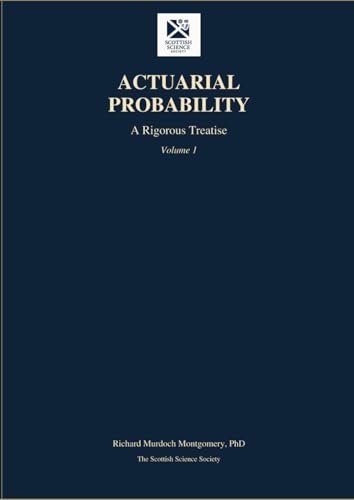

A rigorous, unusually careful first volume that treats actuarial probability as real mathematics rather than a bag of recipes. I found its discipline, definitions, and proof structure exemplary, even where the pace demands real attention from the reader.
Richard Murdoch Montgomery has written a book that does what too many actuarial texts merely promise: it puts probability back on a proper measure-theoretic footing without losing sight of the insurance problems that motivate it. I was struck at once by the sobriety of the exposition. Definitions are stated with precision, hypotheses are not smuggled in by habit, and the results are proved in a way that makes clear exactly where the actuarial interpretation enters and where the mathematics stands on its own. That is no small virtue in a field where hand-waving often passes for technique.
What I admire most is the book’s structural honesty. The development does not flatten probability into a collection of formulas for premiums and reserves; instead, it builds the apparatus carefully and insists on understanding random variables, dependence, expectation, and asymptotics as mathematical objects first. The proofs are generally clean and responsibly paced. When the author passes from abstract probability to mortality models, life contingencies, or aggregate loss structure, the transition feels earned rather than decorative. One sees clearly how the theory supports actuarial practice, and not the other way around.
The book’s depth is also its chief demand on the reader. Montgomery expects mathematical maturity, and he is right to do so. I would not praise this volume for accessibility in the popular sense, but I would praise it for being exact where exactness matters. The notation is disciplined, the assumptions are visible, and there is a welcome reluctance to conceal technical steps behind verbal summaries. In places I might have wished for a slightly gentler signposting of longer arguments, though this is a minor matter; the substantive mathematics is sound, and the reader who keeps pace is rewarded with real understanding rather than mere procedural fluency.
As a first volume, this is an impressive foundation. It establishes a standard of rigour that many more established texts in applied probability would do well to emulate, and it does so without sacrificing the actuarial horizon that gives the subject its distinct interest. I regard it as a serious contribution: exacting, coherent, and evidently checked with care.
Who should read this
This is for graduate students and practitioners who want actuarial probability treated as serious mathematics, not as a handbook of actuarial shortcuts. It will suit readers comfortable with proofs and willing to work for conceptual clarity.
A personal note from Kowalski
I came away with the pleasant feeling of having been taught, not merely informed. That is rarer in actuarial literature than it ought to be, and I value it highly.
Conversation(0)
Join in — no account needed. A name and email are all it takes. Your email is never shown publicly.