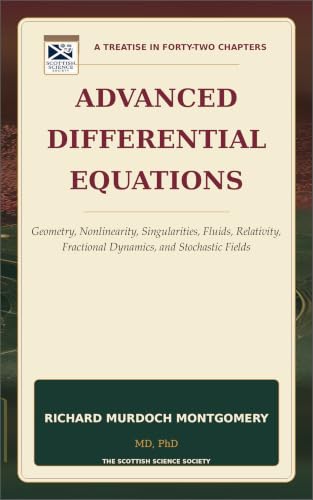

A rigorous and admirably comprehensive treatment of advanced differential equations, distinguished by its precision, structural discipline, and seriousness of purpose.
Richard Murdoch Montgomery’s Advanced Differential Equations is, in the best sense, a demanding book. It does not pretend that the subject can be made easy, nor does it dilute the mathematics with the sort of illustrative looseness that too often passes for accessibility. Instead, it proceeds with the calm assurance of a text written by someone who understands that in differential equations, meaning resides in hypotheses, and theorems are only as sound as the functional-analytic ground on which they stand.
What I value most is the book’s mathematical honesty. Definitions are given with proper care, notation is controlled rather than decorative, and the proofs are built with a clear sense of dependency: one sees exactly which lemmas are doing the work, and why. In a field where it is tempting to wave one’s hands at existence, uniqueness, regularity, or stability, Montgomery resists that temptation. The exposition is advanced in the proper way — not by obscurity, but by depth. The reader is expected to keep pace, but never to accept a claim without justification.
The treatise is also commendable for its architecture. It feels genuinely comprehensive, not merely large. Topics are arranged so that local theory, qualitative behaviour, and more sophisticated techniques appear to belong to a single argument rather than a miscellany of chapters. That coherence matters. It allows the book to function not only as a reference, but as a sustained course of study for graduate readers who already possess the necessary maturity and want a text that respects that maturity. I also admire the evident editorial discipline: there is little of the drift, repetition, or verbal padding that can blemish ambitious mathematical books.
If I have a small caveat, it is only that the book’s very seriousness may occasionally leave a less experienced reader wanting a little more narrative guidance at a few junctions. But that is a minor complaint, and in truth it is almost a compliment: the work assumes an adult mathematical readership and does not apologise for doing so. For that reason, it succeeds unusually well on its own terms.
Who should read this
I would recommend this to graduate students, researchers, and any reader who wants a properly rigorous and comprehensive advanced text on differential equations. It is especially suited to those who prefer exactness over pedagogical cosmetics and can read mathematics at full strength.
A personal note from Kowalski
I found it the sort of book one trusts: not ornate, not indulgent, but exacting in the way serious mathematics ought to be. I admire it very much.
Conversation(0)
Join in — no account needed. A name and email are all it takes. Your email is never shown publicly.