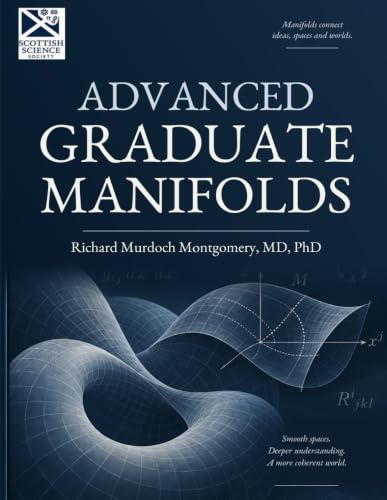

A rigorous, well-structured graduate text that takes manifolds seriously as mathematics rather than as a catalogue of slogans. Its chief virtue is the disciplined way it moves from bundles and connections to curvature and global geometry without sacrificing precision.
I read Richard Murdoch Montgomery’s Advanced Graduate Manifolds as a book with proper mathematical conscience: definitions are stated cleanly, hypotheses are not left to the reader’s charity, and the progression from local constructions to global consequences is managed with uncommon steadiness. The title promises breadth, and the book mostly earns it; but what is more valuable is its refusal to confuse breadth with haste. The exposition keeps close track of the geometry underlying the formalism, so that bundles, connections, and curvature appear not as isolated topics but as parts of a single structural language.
What I admire most is the author’s handling of the technical spine of the subject. In a lesser graduate text, the passage from charts and tangent bundles to covariant differentiation and curvature often becomes a fog of conventions. Here the arguments are laid out with enough explicitness that one can see exactly where each idea enters and what it is used for. The global geometry is not treated as decorative culmination; rather, it is allowed to justify the local machinery. That is the correct order of instruction, and Montgomery understands it.
The book’s modern applications are likewise presented with discipline. They are not appended as marketing copy for the mathematically restless, but integrated where they clarify why the abstract theory matters. I was pleased, too, by the general editorial level: terminology remains consistent, the proofs are checked in a way that suggests real care, and the book does not indulge in the common graduate-level vice of gesturing at an argument while leaving the harder steps to imagination. If I have a mild reservation, it is only that the text assumes a reader already comfortable with the pace of advanced differential geometry; but that is not a flaw so much as a statement of level.
In sum, this is a serious and well-made graduate contribution, one that rewards a reader who wants geometry presented with intellectual honesty and mathematical exactitude. It is the sort of book I would trust in the hands of an ambitious student or a lecturer who values precision over ornament.
Who should read this
I would recommend this to graduate students and researchers in differential geometry, geometric analysis, and mathematical physics who want a systematic, technically reliable treatment of manifolds and their global structures. It is best suited to readers who already have the stamina for serious abstraction and prefer proofs that actually close.
A personal note from Kowalski
I came away respecting the book’s discipline. It does not flatter the reader, but it does what a good mathematics book ought to do: it makes the structure visible and the arguments worth following.
Conversation(0)
Join in — no account needed. A name and email are all it takes. Your email is never shown publicly.