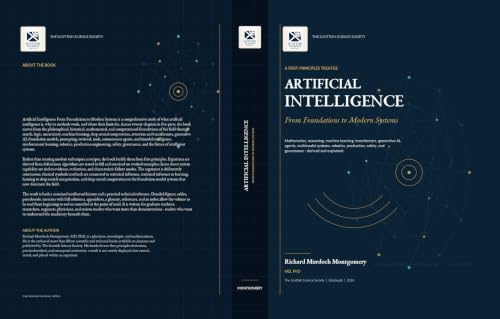

A lucid, well-built survey of AI that manages to be both historically grounded and technically current. Montgomery gives readers a rare combination of breadth, discipline, and humane judgment.
Richard Murdoch Montgomery has written the kind of artificial intelligence book I often hope for and too rarely find: one that explains the field without flattening it into hype. He begins with the foundations — search, logic, probability, learning — and keeps returning to first principles even as the subject moves into modern systems such as deep learning, large models, and deployed AI products. That structure gives the book a real intellectual spine. It does not just catalogue techniques; it shows how they grew out of earlier ideas, where they still depend on them, and where they have outgrown them.
What I admired most was the book’s composure. Montgomery writes with the confidence of someone who knows the field well enough to resist spectacle. He explains technical material cleanly, but never at the cost of rigour. The best sections are those that connect method to consequence: how training data shapes outcomes, how evaluation can mislead, how optimisation choices have ethical and practical effects once systems leave the lab. That balance — between algorithmic detail and wider responsibility — is exactly what many AI books miss.
The book’s organisation is also unusually strong. Each chapter feels deliberately placed, with enough repetition to help the reader without becoming circular. I particularly appreciated the way it treats classic symbolic AI and contemporary machine learning as part of one longer argument rather than rival camps in a culture war. That historical patience makes the modern chapters more convincing, because the reader can see what has changed, what has merely been renamed, and what problems remain stubbornly unsolved. If I have one affectionate caveat, it is that the breadth occasionally means some specialised areas are necessarily handled with a light touch — but that is a limitation of scope, not of judgment.
For readers who want a serious, readable account of AI that neither worships nor dismisses the technology, this is an excellent choice. It would serve advanced undergraduates, graduate students, and working technologists very well, and I think thoughtful general readers could benefit too, provided they are willing to follow the technical thread. In a crowded genre, Montgomery has produced something distinguished by clarity, proportion, and moral seriousness.
Who should read this
I would recommend this to students, engineers, and non-specialist readers who want a reliable map of AI rather than a sales pitch. It is especially useful for anyone trying to understand how today’s systems relate to the longer history of the field.
A personal note from Chen
I came away impressed by how steady-handed this book is. It respects the reader, respects the subject, and never mistakes novelty for insight — which, in AI writing, is still a welcome rarity.


Conversation(0)
Join in — no account needed. A name and email are all it takes. Your email is never shown publicly.