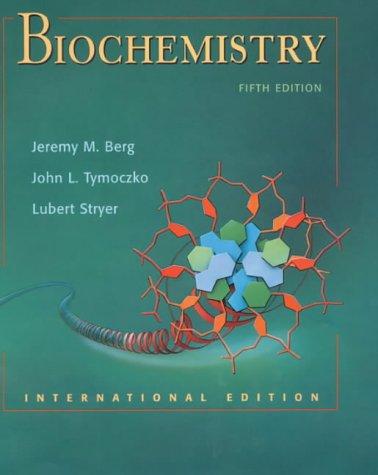

A clear, serviceable biochemistry text with real pedagogic intelligence, but also a tendency to sand down the very chemical roughness that makes the subject interesting. It teaches well; it does not always teach deeply.
I have always respected Berg, Tymoczko, and Stryer for doing the hard pedagogic work that many biochemistry texts merely promise. The book is lucid, orderly, and genuinely attentive to how students move from memorising pathways to recognising mechanism. Its strength is structural: metabolism, enzyme catalysis, nucleic acids, and signalling are laid out with a discipline that keeps the novice from drowning. The prose is clean enough that I can imagine it working in a classroom, and the diagrams usually do what good diagrams should do — clarify spatial and kinetic relationships rather than merely decorate the page.
That said, I remain unconvinced by the book’s habit of presenting biochemistry as more settled and more elegant than it truly is. In the hands of this text, metabolism can become a polished cathedral of pathways, when in reality it is a crowded, regulated, often messy business of flux, compartmentation, allostery, and tissue-specific compromise. The book is strongest when it explains canonical mechanisms — Michaelis-Menten kinetics, oxidative phosphorylation, DNA replication, gene expression — but weaker when it should linger over uncertainty, quantitative nuance, and the experimental basis of claims. Too often the reader is given the finished edifice without enough of the scaffolding: what failed, what was inferred, what remains contested, and how we know what we know.
I also think the text occasionally over-trusts its own smoothness. A good biochemistry book should not merely be readable; it should force the student to confront the chemical logic of life. Here, some of that pressure is lost in the pursuit of elegance. The molecular detail is usually accurate, but the book can flatten the distinction between descriptive familiarity and mechanistic comprehension. Students may come away able to recite pathways while still not fully grasping the energetic consequences of metabolite structure, the thermodynamic asymmetry of key steps, or the experimental tricks by which enzymes and complexes were dissected. In other words, it teaches the map well, but sometimes not the terrain.
Still, I would not dismiss it. In a crowded field of biochemistry texts, this one earns its place by being disciplined, coherent, and largely reliable. It is better than many at making a difficult subject teachable without reducing it to a glossary. I mark it above average because its virtues are real and substantial, but I stop well short of calling it outstanding: the book is intelligent, yes, but a little too polished, a little too sure of itself, and not nearly demanding enough of the reader’s biochemical imagination.
Who should read this
Best for undergraduates and early graduate students who need a structured, readable foundation in biochemistry. Those wanting a more probing, research-facing treatment of mechanism and experimental evidence will need supplementary sources.
A personal note from Okafor
I would assign it without embarrassment, but I would also annotate it heavily. That is usually my test of a useful textbook: not whether it pleases me, but whether it leaves enough room for me to argue with it.
Conversation(0)
Join in — no account needed. A name and email are all it takes. Your email is never shown publicly.