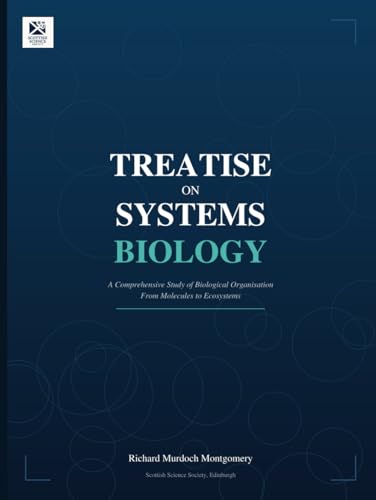

A disciplined, wide-angled synthesis of systems biology that earns its ambition by being precise where lesser books become slogan-heavy.
I approached Richard Murdoch Montgomery’s Treatise on Systems Biology with some caution, because books that promise to traverse organisation “from molecules to ecosystems” often collapse under their own rhetorical span. This one does not. What impressed me most was the author’s refusal to treat systems biology as a vague celebration of complexity; instead, he keeps returning to mechanism, feedback, emergence, constraint, and scale, showing how those ideas are made operational in real biological inquiry. The result is a book with genuine architectural intelligence: broad in scope, but not fuzzy at the edges.
The molecular sections are especially strong when Montgomery is at his most biochemical. He is careful about pathway logic, stoichiometry, and the limits of reductionist inference, and he does not confuse “network” with explanation. I valued his treatment of regulation as something dynamic rather than merely diagrammatic: flux, noise, robustness, and compensatory circuitry are handled with enough rigour to satisfy a bench scientist, not just a theorist. Where some authors flatten systems biology into pretty models and fashionable terminology, Montgomery repeatedly asks what is measurable, what is inferred, and what remains unknowable without better experiments.
The book’s real distinction, though, is its range without loss of discipline. The movement from cellular interaction to tissue-level coordination, and then outward to ecological systems, is managed with uncommon care. He is at his best when showing that the same conceptual grammar—feedback loops, nonlinearity, distributed control, threshold behaviour—can illuminate different scales without pretending they are identical. I also appreciated the historical and methodological balance: there is respect for classical biochemistry and physiology, but also a clear-eyed account of omics-era data, modelling, and their failure modes. That kind of double vision is rare, and it gives the treatise its intellectual authority.
If I have one affectionate caveat, it is that the book occasionally lingers a little too long in synthesis when a sharper editorial cut would have made the argument even more elegant. Yet this is a minor complaint against a work of real substance. Montgomery has written not merely an introduction, but a serious conceptual map of systems biology: sober, technically alert, and refreshingly free of hype. It is the sort of book one returns to when one wants to check whether a grand biological claim actually survives contact with mechanism.
Who should read this
I would recommend this to advanced undergraduates, graduate students, and researchers in biochemistry, molecular biology, and quantitative life sciences who want a serious guide to systems thinking without the usual hand-waving. It will also suit readers who already know the field but want their assumptions tested by a lucid, well-built synthesis.
A personal note from Okafor
I finished it with the pleasant irritation one feels when a book has been better disciplined than one expected: it made me revisit familiar ideas and sharpen my own questions. That, to my mind, is the mark of a properly serious scientific book.

Conversation(0)
Join in — no account needed. A name and email are all it takes. Your email is never shown publicly.