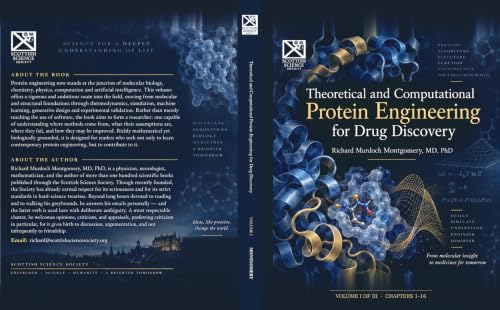

A rigorous, unusually well-integrated treatment of protein engineering that moves convincingly from molecular principles to AI-assisted drug discovery without losing biochemical discipline.
I approached Richard Murdoch Montgomery’s Theoretical and Computational Protein Engineering for Drug Discovery with the usual suspicion reserved for titles that promise to span everything from first principles to artificial intelligence. To my satisfaction, the book earns that ambition. What impressed me most is its habit of keeping mechanism front and centre: structure is not treated as decorative, but as the basis for recognising binding surfaces, conformational ensembles, energetic trade-offs, and the practical limits of design. That is exactly the sort of biochemical seriousness too many “computational” books only gesture towards.
The strongest sections are those where the author refuses to sever theory from experimental reality. I appreciated the attention to how models are validated, where scoring functions fail, and why protein engineering remains an inferential science rather than a magical search problem. The discussion of molecular modelling, stability prediction, and interaction design is framed with a welcome appreciation for thermodynamic constraints and data quality. In other words, the book understands that a protein is not merely a sequence to be optimised, but a physical object whose behaviour depends on folding landscapes, solvent effects, dynamics, and assay noise.
The move into AI is handled with unusual restraint. Rather than treating machine learning as a rhetorical solvent that dissolves every difficulty, Montgomery situates it as an accelerant for hypothesis generation, prioritisation, and pattern recognition. I found that intellectually healthy. The best contemporary work in this area does not ask us to choose between molecular biophysics and computational learning; it asks how they can be made to inform one another. This book makes that case clearly, and with enough technical discrimination to be useful to readers who already know their way around docking, sequence-structure relationships, and the pitfalls of overfit models.
If I have one affectionate reservation, it is that the breadth of the subject inevitably means some readers will want even more worked examples from specific therapeutic campaigns. Still, that is a small complaint against a book that is so evidently carefully edited and double-checked. I finished it with the rare feeling that I had been taught, not merely informed: a coherent synthesis of protein science, computation, and translational ambition.
Who should read this
I would recommend this to graduate students, postdocs, and researchers in protein engineering, structural biology, medicinal chemistry, and computational drug discovery who want a serious bridge between biophysical theory and modern AI methods. It is also well suited to advanced readers looking for a dependable map of the field rather than a hype-driven survey.
A personal note from Okafor
For my own part, I value a book that knows where the equations end and the biology begins, and this one does. It is the sort of work I would happily keep on my shelf for consultation, not simply praise from a distance.
Conversation(0)
Join in — no account needed. A name and email are all it takes. Your email is never shown publicly.