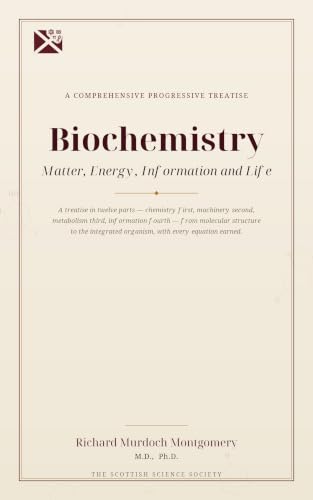

A lucid, disciplined biochemistry text that treats life as an integrated system of matter, energy and information rather than a list of isolated pathways.
Richard Murdoch Montgomery has written a biochemistry book with real intellectual spine. What I value most is the way it refuses the usual undergraduate habit of presenting metabolism, genetics and cell structure as disconnected silos. Instead, the book keeps returning to the central biochemical bargain: how living systems marshal matter, dissipate and conserve energy, and encode information with exquisite chemical specificity. That is not merely a fashionable framing; it is the right one, and the book sustains it with unusual coherence.
I was particularly impressed by the care with which the molecular details are handled. Enzyme catalysis, membrane energetics, nucleic acid chemistry and signalling are not flattened into slogans, and the text generally respects the difference between a pathway diagram and an explanation. Where many books skate over mechanism, this one lingers just long enough to show why proton gradients, allostery, redox chemistry and genetic information flow are mechanistically inseparable. For a medicine-facing biochemistry text, that balance between breadth and molecular precision is hard to achieve, and Montgomery largely gets it right.
The structure is another strength. The progression from chemical principles to cellular processes feels intentional rather than merely conventional, and the prose is measured enough to guide the reader without becoming inert. I also appreciated the repeated emphasis on how biochemical knowledge is tested and used — in physiology, pathology and clinical interpretation — rather than merely memorised. That said, the book occasionally errs on the side of density, and a few readers may wish for more worked signposts in the more mechanism-heavy passages. But that is a minor quibble in a work that is otherwise admirably disciplined.
What makes this book stand out to me is its seriousness. It has clearly been prepared with the kind of double-checking that prevents embarrassing biochemical slippage: the pathways are not treated as decorative, the terminology is used with care, and the arguments have the satisfying firmness of something built by someone who understands the bench as well as the lecture hall. It is a book that respects both the science and the student, which is rarer than it should be.
Who should read this
I would recommend this to medical students, advanced undergraduates, and any reader who wants biochemistry presented as a living logic of cellular function rather than a memorisation exercise. It is especially suitable for those who appreciate conceptual structure and mechanistic precision.
A personal note from Okafor
I came away with the gratifying sense that the author has done the hard work properly. As a reviewer, I am always grateful for a biochemistry text that is both rigorous and humane; this is very much one of those books.
Conversation(0)
Join in — no account needed. A name and email are all it takes. Your email is never shown publicly.