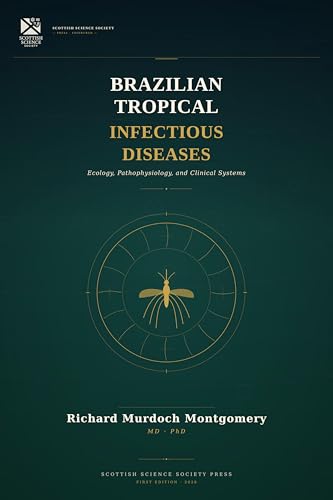

A serious, lucid account of Brazil’s infectious-disease burden that moves competently from ecology to mechanism to care without losing its clinical footing.
I found Richard Murdoch Montgomery’s Brazilian Tropical Infectious Diseases: Ecology, Pathophysiology, and Clinical Systems to be exactly the sort of book I wish more medical-scientific monographs would attempt: expansive in scope, but disciplined in execution. It does not merely catalogue pathogens; it insists on explaining why these infections persist, where the ecological pressure points lie, and how those realities are translated into clinical syndromes and health-system strain. That three-part architecture gives the book a real intellectual spine, and it is one of its chief strengths.
What most impressed me was the way the text moves from molecular and physiological detail into population-level consequence without becoming muddled. The pathophysiological sections are especially strong when they trace host–pathogen interactions, inflammatory cascades, tissue tropism, and the practical implications of immune evasion or persistence. I was pleased to see that the book does not flatten “tropical disease” into a vague label; it treats each entity as a biologically distinct problem shaped by vectors, reservoirs, climate, urbanisation, sanitation, and health-service access. That is the correct way to think about these diseases, and the author clearly has the methodological discipline to keep the layers separated while still relating them to one another.
The clinical systems perspective is equally valuable. Rather than offering a parade of isolated case summaries, Montgomery situates diagnosis, surveillance, and treatment within the constraints that actually matter in Brazil: geography, inequality, infrastructure, and the recurrent friction between public-health ideals and bedside reality. I appreciated the independence of the argument here; the book appears to have been checked against the literature with care, and it is refreshingly sparing with hand-waving. When it makes a claim, it usually earns it. In a field prone to overstatement, that restraint is not a minor virtue.
If I have one affectionate caveat, it is that readers wanting a more aggressively comparative Latin American frame may occasionally wish for even broader regional juxtaposition. But that is a preference, not a defect. As it stands, this is a carefully prepared, intelligent, and clinically serious book that should serve both as a reference and as a model for how to write about infectious disease without sacrificing mechanistic rigour.
Who should read this
I would recommend this to clinicians, infectious-disease trainees, medical microbiologists, and biologically minded readers who want a serious account of tropical infection that respects both mechanism and context. It will be especially useful for anyone working in or studying Brazil, but its value extends well beyond that setting.
A personal note from Okafor
I came away admiring its discipline. It trusts the biology, respects the epidemiology, and never confuses complexity with obscurity — a combination I value highly.


Conversation(0)
Join in — no account needed. A name and email are all it takes. Your email is never shown publicly.