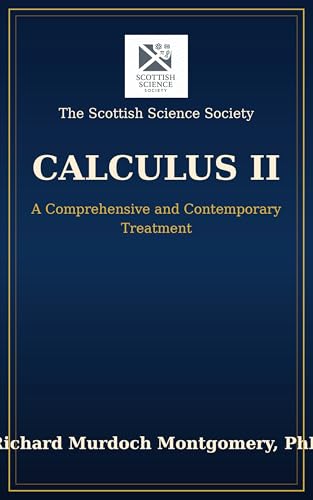

A rigorous and admirably structured second calculus volume: modern in presentation, classical in discipline, and unusually attentive to proof-level detail.
I found Richard Murdoch Montgomery’s Calculus II to be the kind of textbook I trust: methodical, exacting, and unwilling to blur the line between heuristic insight and mathematical justification. It covers the familiar terrain of the second calculus course — techniques of integration, applications, sequences and series, parametric and polar methods, and the usual analytic apparatus — but it does so with a seriousness of purpose that is not always present in contemporary course texts. The tone is accessible without being slack, and the exposition proceeds with a welcome sense that the student is being taught not merely to manipulate formulas, but to understand why those formulas are legitimate.
What impressed me most was the book’s discipline in definition and proof. The transition from computational calculus to more abstract analysis is handled with care: convergence questions are not waved away, and the treatment of series is especially strong in the way it distinguishes intuition from theorem. I was pleased to see the author preserve mathematical honesty in places where many texts retreat into recipes. Even when the material is standard, the presentation is not perfunctory; the logical dependencies are made visible, and that alone raises the book above the merely serviceable.
The book’s contemporary character lies less in any fashionable simplification than in its clarity of organisation and its awareness of how students actually encounter the subject now. I appreciated the balance between worked examples and formal development. The examples are chosen with enough variety to illuminate the theory, yet they are not so numerous as to crowd out the main line of argument. The result is a text that can support both a serious independent learner and a properly run university course.
If I have a small reservation, it is only that the very breadth of the enterprise occasionally gives the prose a slightly compressed feel; one senses that the author prefers density to ornament, and a few readers may want more narrative breathing space. But this is a minor complaint. In mathematical terms, the book earns its ambition: it is careful, competent, and substantively reliable, with a level of editorial polish that makes it easy to recommend without hesitation.
Who should read this
I would recommend this to students taking a serious second-semester calculus course, and to instructors who want a text that respects the subject’s logical structure. It is also well suited to motivated self-study, provided the reader is willing to work rather than skim.
A personal note from Kowalski
For my part, I value a calculus book that refuses to treat rigour as decorative. This one does not condescend to the reader, and I admire it for that.
Conversation(0)
Join in — no account needed. A name and email are all it takes. Your email is never shown publicly.