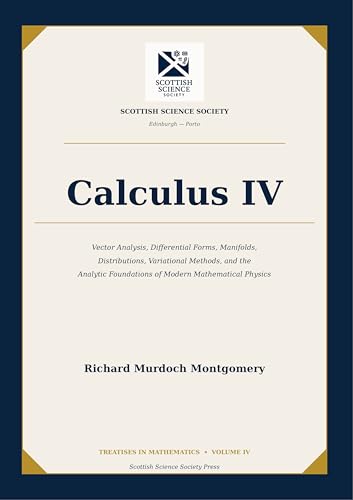

An ambitious and unusually coherent advanced calculus text that earns its scope by treating analysis, geometry, and physics as a single mathematical conversation. I found it rigorous, well paced, and intellectually serious throughout.
Richard Murdoch Montgomery’s Calculus IV is, in the best sense, a book of transition: it leads the reader from familiar multivariable calculus into the language in which modern analysis and mathematical physics actually speak. What impressed me first was not the breadth of its syllabus — vector analysis, differential forms, manifolds, distributions, variational methods — but the discipline with which that breadth is organised. The book does not merely accumulate topics; it arranges them so that each new abstraction appears as a necessary sharpening of an earlier idea. That is a harder thing to do than to write yet another competent survey, and Montgomery largely succeeds at it.
Mathematically, the treatment is serious and, for the most part, exacting. I was especially pleased by the way differential forms are allowed to do real work rather than serving as decorative notation. The progression from vector calculus identities to the coordinate-free formulation is handled with admirable restraint, and the author is careful not to obscure the underlying analytic content beneath formalism. Likewise, the sections on distributions and variational methods display the right temperament: they are sufficiently concise to preserve momentum, but not so compressed that the reader is asked to accept miracles. One can feel that definitions and hypotheses have been checked, not merely gestured at.
The book’s principal strength is its integrative ambition. In lesser hands, a text that aims to connect manifolds, weak derivatives, and the analytic foundations of physics can become a catalogue of disconnected techniques. Here, however, the material is made to illuminate itself. The reader is repeatedly shown why the abstract apparatus matters: Stokes-type theorems, weak formulations, and geometric language are not isolated ornaments but the natural grammar of the subject. That makes the book particularly rewarding for a mathematically mature reader who wants not only methods, but structure.
If I have one small reservation, it is that the pace will occasionally feel brisk to anyone arriving without a secure prior command of proof-based analysis. Yet I regard this less as a defect than as an honest choice of register. A book with this title should not apologise for its seriousness, and this one does not. Montgomery has written a work that is both ambitious and disciplined, and in a field too often divided between oversimplification and obscurity, that is no minor achievement.
Who should read this
I should recommend this to advanced undergraduates, beginning graduate students, and working physicists or applied mathematicians who want a rigorous bridge from calculus to modern analysis and geometry. It is best suited to readers who already welcome abstraction and want the reasons behind it, not merely the recipes.
A personal note from Kowalski
I admire this book because it respects the reader’s intelligence without indulging in obscurity. It is exactly the sort of mathematically honest text I wish were more common.
Conversation(0)
Join in — no account needed. A name and email are all it takes. Your email is never shown publicly.