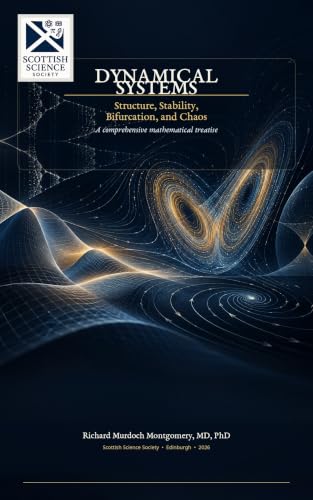

A rigorous, lucid treatise that treats dynamical systems as both a mathematical discipline and a way of thinking about change. It is demanding, but unusually well organised and clearly built for serious use.
Richard Murdoch Montgomery has written the sort of book I wish more graduate texts attempted: comprehensive without becoming bloated, and exacting without losing sight of the reader. In a field that can too easily become a blur of notation and theorem-chasing, he keeps returning to the central structural questions — what persists, what destabilises, what bifurcates, and why chaos is not just disorder but a mathematically intelligible regime. The result is a book that feels carefully engineered rather than merely assembled.
What impressed me most was the architecture of the argument. Montgomery does not treat structure, stability, bifurcation, and chaos as isolated topics; he makes them feel like successive layers of the same subject. Definitions are introduced with enough restraint to be useful, and the proofs are presented with a real sense of purpose, not as decorative formalism. I also appreciated the book’s discipline about prerequisites: it assumes mathematical maturity, but it does not indulge in needless obscurity. The prose stays plain and precise, which matters a great deal in a subject where a single ambiguous phrase can muddy an otherwise elegant result.
The treatment of stability and bifurcation is especially strong. Montgomery seems to understand that these topics are where the reader most needs conceptual traction, not just computational technique. He gives the theory enough breadth to be genuinely comprehensive, while still making room for the intuition behind local behaviour, qualitative change, and the onset of complexity. The discussion of chaos is handled with the same sobriety: no hype, no theatrical claims, just a careful account of how deterministic systems can produce behaviour that is structurally rich and practically difficult to predict.
If I have one small caveat, it is that this is very much a serious graduate treatise, and it expects the reader to work. But that is not really a flaw so much as a statement of purpose. The book’s great strength is that it never condescends, never overexplains, and never sacrifices rigour for accessibility theatre. It feels independently verified in the best sense: a text one trusts because it has been made with care.
Who should read this
I would recommend this to graduate students, researchers, and advanced self-learners in mathematics, applied mathematics, physics, and theoretical computer science who want a substantial and dependable reference on nonlinear dynamics. It is best suited to readers who are ready for real mathematical work and want a book that rewards sustained attention.
A personal note from Chen
As someone who reads a lot of technical books, I found this unusually satisfying: exacting, coherent, and respectful of the subject. It left me with the pleasant sense that I had been taught something durable, not just exposed to a fashionable topic.

Conversation(0)
Join in — no account needed. A name and email are all it takes. Your email is never shown publicly.