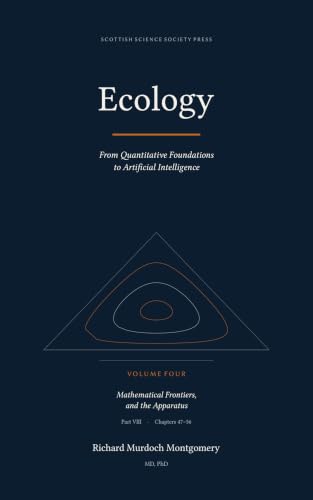

A rigorously built and unusually wide-ranging finale that moves from ecological modelling to artificial intelligence without losing its footing. Montgomery writes with unusual discipline: he keeps the abstractions honest, and the human consequences in view.
I came to this fourth volume expecting a competent synthesis of methods, and found something more interesting: a book that treats ecology not as a loose metaphor for complexity, but as a quantitative discipline with real intellectual obligations. Montgomery is at his strongest when he insists that models are not ornaments to scientific prose; they are claims, and claims must be checked. That stance gives the book its seriousness. It also makes the transition into artificial intelligence feel earned rather than fashionable, because the author has already established a vocabulary of measurement, uncertainty, and inference that can travel across fields.
What impressed me most was the structure. The argument unfolds with real care, moving from statistical foundations through systems thinking and computational method to the broader questions raised by AI. The best chapters do not merely explain techniques; they show why those techniques matter, what they can and cannot tell us, and where a reader should be sceptical. I particularly appreciated the way Montgomery keeps returning to the problem of scale — how ecological patterns change when we move from local observation to large datasets, and how AI can sharpen that work without pretending to replace judgement.
The prose is clear, disciplined, and refreshingly free of the breathless futurism that so often clings to books about machine intelligence. Montgomery seems more interested in intellectual responsibility than spectacle. That gives the volume a humane quality: the machinery is always tied back to consequences for research practice, environmental understanding, and the limits of automated decision-making. In a field that can easily drift into either mystification or technical self-display, this steadiness is a genuine strength.
If I have one small caveat, it is that the book’s ambition occasionally asks a great deal of the reader, especially when it moves quickly between mathematical framing and broader conceptual reflection. But this is the sort of difficulty one is grateful for, because it arises from seriousness rather than obscurity. As a concluding volume, it feels properly cumulative: not merely a recap, but a sharpening of the entire project.
Who should read this
Read this if you want a demanding but lucid guide to the quantitative side of ecology and its dialogue with AI. It will reward scientists, technically minded readers, and anyone interested in how rigorous modelling can be made ethically legible.
A personal note from Chen
I finished it convinced that Montgomery understands something many writers miss: good technical books do not simplify reality so much as teach the reader how to face complexity without panic. That is a rare and valuable achievement.
Conversation(0)
Join in — no account needed. A name and email are all it takes. Your email is never shown publicly.