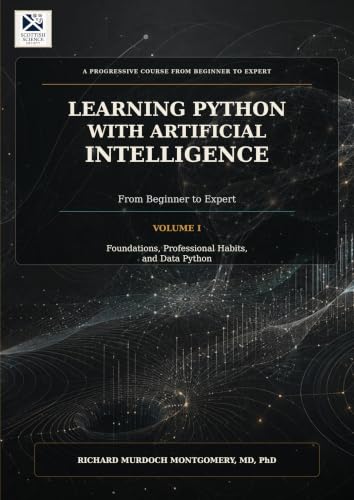

An unusually practical and well-structured guide that teaches Python by letting AI be both subject and tutor. It is ambitious without being foggy, and its real strength is the way it keeps code, concepts, and applications in steady conversation.
Richard Murdoch Montgomery has done something more difficult than it first appears: he has written an introductory Python book that does not talk down to beginners while still giving them a clear path toward serious work. The volume is organised with unusual care, and I appreciated how often it pauses to explain not just what a piece of code does, but why that choice matters in practice. That sense of method is the book’s strongest quality. It feels planned by someone who understands that a good technical manual should reduce friction rather than create it.
What makes this title stand out is its use of artificial intelligence as a teaching frame instead of a gimmick. The AI material is not merely sprinkled on top to chase a trend; it is woven into the learning process so that readers encounter Python syntax, problem-solving habits, and computational thinking in a context that feels contemporary and useful. I found the book especially effective when it shifts from abstract explanation to application, because it keeps the reader oriented: here is the concept, here is the code, here is what happens when you run it, and here is why the result matters.
The prose is plain-spoken and patient, which is exactly what a broad instructional book needs. It avoids the common failure mode of beginner texts that either oversimplify or drown the reader in technical clutter. Instead, it builds confidence step by step, and the progression feels genuinely cumulative. By the time the book reaches more advanced territory, it has earned the reader’s trust. That said, its comprehensiveness means it sometimes moves with the briskness of a well-run syllabus rather than the leisurely pace of a tutorial, which I take as a minor and largely affectionate caveat rather than a flaw.
I also value the book’s tone: serious without being gloomy, ambitious without making grandiose promises. It treats Python and AI as tools for disciplined work, not magic. In a field crowded with books that either chase novelty or retreat into dryness, this one finds a persuasive middle ground. It is the sort of manual I would be comfortable recommending to a self-directed learner who wants structure, clarity, and a sense that the material has been checked and rechecked before reaching the page.
Who should read this
I would recommend this to beginners who want a structured route into Python and to intermediate readers who want to connect programming basics with practical AI concepts. It will be especially useful for self-study, where clarity and sequence matter more than flash.
A personal note from Chen
I came away admiring the book’s discipline. It knows exactly what kind of help a learner needs, and it offers that help with intelligence and restraint.
Conversation(0)
Join in — no account needed. A name and email are all it takes. Your email is never shown publicly.