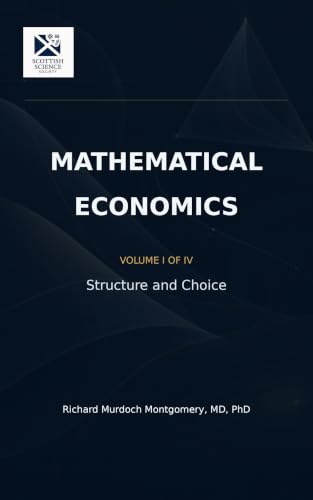

A rigorous and unusually well-controlled introduction to mathematical economics: abstract enough to be serious, but written with genuine discipline and care. I found it intellectually exacting, and, more importantly, mathematically honest.
Richard Murdoch Montgomery has written a book that understands mathematical economics as more than the application of calculus to familiar slogans. In this first volume, the emphasis on structure and choice gives the subject a proper spine: sets, relations, preference orderings, feasibility, optimisation, and the formal conditions under which economic statements may even be made. I was grateful for the book’s refusal to rush past foundational questions. It treats definitions as obligations, not ornament, and the resulting architecture is steady and persuasive.
What impressed me most was the discipline of the exposition. The arguments are presented with a rare concern for internal coherence, and the progression from abstract form to economic interpretation is handled with admirable restraint. Too many texts in this area confuse elegance with brevity; Montgomery does not. He earns his abstractions. When a theorem is stated, its hypotheses are visible and its scope is not overstated; when an economic interpretation is drawn, it is tethered to the mathematics rather than merely illustrated by it. That distinction is not cosmetic — it is the difference between a serious graduate text and a decorative one.
The book’s treatment of choice is especially strong. One senses that the author has thought carefully about what is being formalised and what is merely being renamed. The result is not a parade of axioms but a sustained inquiry into how structure constrains decision-making. For mathematically trained readers, this is refreshing. For economists with sufficient mathematical maturity, it offers a reliable bridge between conceptual language and rigorous proof. I also appreciated the sense of editorial care: the presentation suggests a work independently checked for consistency, not a manuscript left to chance.
If I have one small reservation, it is that the density of the formal apparatus will inevitably demand patience from readers coming from a less abstract tradition. Yet this is scarcely a defect in a graduate volume of this kind; indeed, it is part of the book’s integrity. Montgomery does not flatter the reader, but he does respect the subject. That is a better bargain than accessibility purchased at the expense of precision.
Who should read this
I would recommend this volume to graduate students and researchers who want mathematical economics treated as a genuine mathematical discipline, not a catalogue of economic examples. It is especially well suited to readers who value axiomatic structure, exact definitions, and carefully proved results.
A personal note from Kowalski
I admire books that know where their foundations lie and do not pretend otherwise. This one does; and for that reason, I trust it.
Conversation(0)
Join in — no account needed. A name and email are all it takes. Your email is never shown publicly.