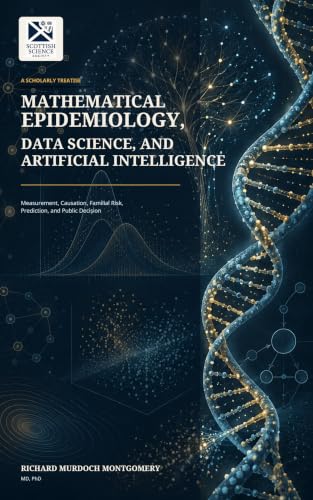

An unusually serious and methodologically alert intervention in mathematical epidemiology, this book insists that measurement, causation, prediction, and decision are distinct problems and treats them as such. Its argument is disciplined, contemporary, and refreshingly unwilling to blur statistical convenience into scientific inference.
I found this book impressive in its intellectual self-command. Richard Murdoch Montgomery does not merely gather together epidemiology, data science, and artificial intelligence under one fashionable roof; he distinguishes them with care, and then asks what each can properly contribute to mathematical reasoning about disease. That insistence on conceptual separation is, in my view, the book’s chief strength. Too many works in this area slide too quickly from association to explanation, or from prediction to policy. Here the transitions are examined rather than assumed, which is exactly what a mathematically serious treatment ought to do.
The structure is notably well judged. Measurement is handled not as a preliminary nuisance, but as a foundational mathematical issue: if the data are ill-posed, noisy, biased, or socially mediated, then no subsequent modelling rescue will be sufficient. Montgomery’s discussion of causation is similarly disciplined. I appreciated the refusal of simple slogans in favour of a more exact account of what can, and cannot, be inferred from observational material, family structure, and population-level signals. The book’s treatment of familial risk is particularly effective in this respect, because it forces the reader to confront the entanglement of inheritance, environment, and ascertainment rather than treating them as neatly separable components.
Where the book excels most is in its handling of prediction and public decision. It understands that a model may be valuable without being causal, and causal without being immediately actionable; the relevant question is always what kind of inference is being attempted, and at what cost. This is a mature and, in the present climate, necessary distinction. The discussion of artificial intelligence is likewise sober: neither celebratory nor dismissive, but technically alert to the difference between algorithmic performance and scientific understanding. I was particularly pleased by the absence of hand-waving around “AI” as a catch-all explanatory badge.
If I have one small caveat, it is only that the book’s density will not spare the impatient reader. But that is less a defect than a mark of seriousness. The prose is exact, the progression cumulative, and the conceptual architecture more carefully engineered than is common in interdisciplinary mathematical writing. This is a work that respects both the mathematics and the public consequences of using it, and it does so with admirable rigour.
Who should read this
I would recommend this to readers who already know they want a mathematically exact account of epidemiology rather than a general introduction: applied mathematicians, quantitative epidemiologists, statisticians, and philosophically attentive data scientists. It will also repay anyone interested in how prediction, causation, and policy should be kept analytically distinct.
A personal note from Kowalski
I came away with the pleasant sense that the book had refused all easy consolations and, in doing so, become more useful. That is my sort of mathematical seriousness.
Conversation(0)
Join in — no account needed. A name and email are all it takes. Your email is never shown publicly.