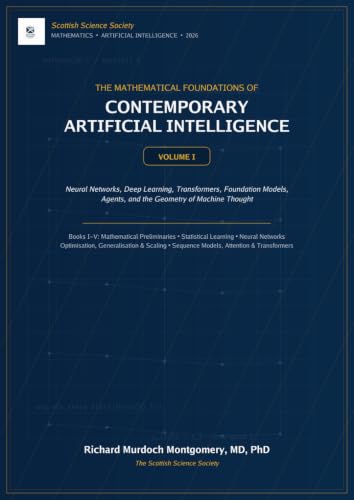

An unusually rigorous and lucid attempt to put the mathematical spine back into modern AI. It is ambitious, sometimes dense, but consistently disciplined, and I found its architectural clarity genuinely valuable.
I came away from Richard Murdoch Montgomery’s "Mathematical Foundations AI VOL 1" impressed by how seriously it treats the subject. Rather than offering the familiar parade of buzzwords, it insists that neural networks, deep learning, transformers, foundation models, and agents all make sense only when the underlying mathematics is made explicit. That choice gives the book an unusual intellectual honesty: it does not flatter the reader with easy analogies, but it does reward close reading with a clearer sense of what these systems are actually doing.
What I particularly admired was the book’s structure. It moves with purpose from core ideas in neural computation through to the geometry of machine thought, and it makes the transitions feel motivated rather than arbitrary. The mathematical material is presented as a set of tools for understanding modern AI systems, not as ornament. In that respect the book does something many technical texts fail to do: it connects formalism to design decisions. You see why attention mechanisms matter, why representation geometry matters, and why the behaviour of agents cannot be reduced to marketing language about intelligence.
The prose is careful and methodical, which suits the topic. Montgomery writes as someone who wants the reader to follow the argument, not merely admire it. There is a refreshing absence of hype, especially in chapters that could easily have slipped into speculative overstatement. Instead, the book keeps returning to the same useful question: what mathematical structure helps explain the behaviour of these systems, and where do the limits of that explanation begin? That restraint gives the book real credibility.
If I have one small caveat, it is that the density that makes the book valuable will also make it demanding for readers without a solid technical background. But that is less a flaw than a consequence of seriousness. For graduate students, researchers, and practitioners who want more than a surface tour of AI, this is a strong and intelligently built volume, one that earns its authority the hard way.
Who should read this
I would recommend this to readers with at least some comfort in mathematics and machine learning — especially students, engineers, and researchers who want a deeper conceptual framework for current AI. It is also a fine choice for anyone tired of inflated talk about AI and looking instead for a precise, grounded account.
A personal note from Chen
I appreciate books that respect both the reader and the subject, and this one does exactly that. It left me with the satisfying feeling of having learned not just more, but better.

Conversation(0)
Join in — no account needed. A name and email are all it takes. Your email is never shown publicly.