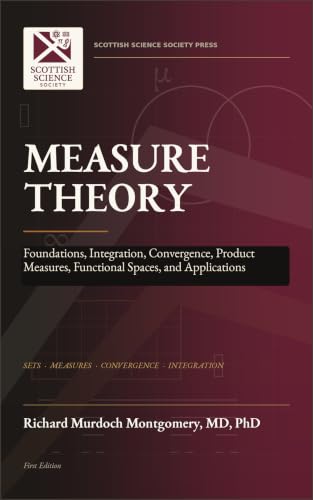

A rigorous and unusually well-judged graduate text: broad in scope, but disciplined enough to keep the measure-theoretic foundations in clear view. I admire its proof-level seriousness and the way it connects core theory to product constructions, convergence, and functional-analytic applications without losing precision.
I found Richard Murdoch Montgomery’s MEASURE THEORY to be a genuinely accomplished graduate book: serious in its aims, exact in its language, and evidently built with a mathematician’s intolerance for loose ends. The range advertised in the subtitle is not decorative. The book moves from the foundations of measurable spaces and measures through integration and modes of convergence, then out into product measures and functional spaces, while preserving a coherent internal logic rather than assembling disconnected topics. That architectural discipline is, in my view, one of its principal merits.
What I value most is the author’s respect for proofs. Definitions are not merely stated; they are positioned so that the subsequent theorems feel earned rather than asserted. The development of integration is handled with proper care, and the treatment of convergence is evidently designed to distinguish the hypotheses one actually needs from the ones one merely hopes for. In a subject where many expositions blur the boundary between intuition and proof, this book keeps the boundary visible. I was especially pleased by the way product measures and the beginnings of functional-space theory are integrated into the main narrative, rather than appended as an afterthought.
The book’s graduate level is, happily, real. It does not condescend to the reader, and it does not dilute the subject with the sort of motivational rhetoric that too often substitutes for argument. At the same time, it is not needlessly austere: the exposition is careful enough that the reader can see why each technical layer has been introduced. The result is a text that should serve both as a course book and as a reliable reference for a reader who wants to understand how measure theory actually functions as a foundation for analysis.
If I have a small reservation, it is only the familiar one that a book of this scope can ask a great deal of its reader; but that is less a flaw than the price of seriousness. Montgomery’s reward for that demand is a text of real substance, one that earns its abstraction by using it with precision. I came away with the impression of a book that has been not only written, but properly checked — a distinction, in advanced mathematics, that matters enormously.
Who should read this
This is for graduate students and researchers who want a rigorous, theory-first account of measure theory with enough breadth to support later work in analysis and functional spaces. It is especially suitable for readers who prefer proof-driven exposition to pedagogical simplification.
A personal note from Kowalski
I respect books that know exactly what they are doing and do it without theatricality; this is one of them. It is the sort of measure theory text I would trust in a seminar room and on a working shelf alike.
Conversation(0)
Join in — no account needed. A name and email are all it takes. Your email is never shown publicly.