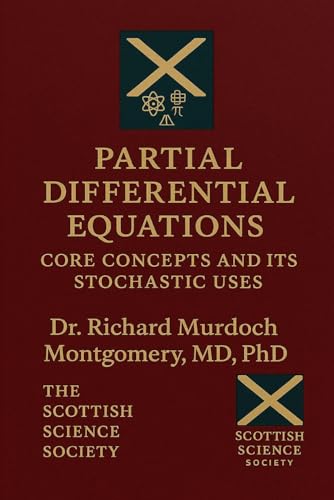

A demanding and well-calibrated treatment of PDEs that respects the reader’s intelligence without surrendering to abstraction for its own sake.
I found Richard Murdoch Montgomery’s Partial Differential Equations: Theory, Methods, and Applications to be exactly the sort of book I trust in advanced mathematics: disciplined in structure, careful in notation, and unwilling to confuse motivation with proof. It presents the central analytic ideas of the subject with genuine seriousness, and it does so without the common vice of flattening difficult arguments into hand-waving summaries. The result is a text that feels both teachable and mathematically honest.
What I admire most is the book’s control of its exposition. Definitions arrive when they are needed and, more importantly, are used consistently thereafter; theorems are not merely stated but placed within a clear logical architecture. The treatment of existence, uniqueness, and qualitative behaviour is rigorous enough to satisfy a mathematically mature reader, while the methods section does real work rather than serving as a catalogue. I was particularly pleased by the way the text keeps the analytical foundations in view even when moving toward applications: one never loses sight of what is being proved, under what hypotheses, and why those hypotheses matter.
The applications are handled with restraint and intelligence. Rather than collecting fashionable examples to decorate the theory, Montgomery selects models that genuinely illuminate the structure of the equations. This gives the book a seriousness that many PDE texts lack. I also appreciate the editorial care: the pacing is measured, the transitions are clean, and the argument is checked closely enough that one can read with confidence. That is not a trivial merit in a subject where imprecision can so easily masquerade as insight.
If I have a small affectionate reservation, it is only that the book asks a great deal of its reader and is not always eager to linger over every heuristic intuition. Yet in a serious PDE text, this is hardly a defect; it is, in truth, often a virtue. Montgomery has written a work of real substance, one that earns its abstraction and respects the standards of the discipline.
Who should read this
I would recommend this book to advanced undergraduates, graduate students, and instructors who want a rigorous PDE text with genuine mathematical backbone. It is especially suitable for readers who prefer careful theorem-proof development over a purely applied or intuition-first approach.
A personal note from Kowalski
I admired the book’s discipline. It has the rare quality of making me trust every step, which in PDE is praise of the highest order.
Conversation(0)
Join in — no account needed. A name and email are all it takes. Your email is never shown publicly.